


COPYRIGHT © 2022 COFF International Co., ltd. ALL RIGHTS RESERVED


When you start searching for a mash tun distillery, you want equipment that matches your production goals and fits your space. You need to look at several important criteria before selecting the right mash tun.
| Criteria | Description |
|---|---|
| Material | Stainless steel gives durability and easy cleaning. Copper can add unique flavors. |
| Insulation | Good insulation helps you save energy and keeps brewing temperatures stable. |
| Heating Options | Electric heating works well for small setups. Steam heating gives even warmth and saves energy. |
| Space Requirements | Measure your distillery carefully to make sure the mash tun brewing system fits safely and efficiently. |
| Capacity | Choose a size that matches your batch needs and plans for future growth. |

You use a mash tun to start the journey from grain to whisky. This vessel holds the grist, which is crushed malted barley or other grains. You add hot water to the mash tun and mix the grist. The heat helps break down starches in the grains. The mash tun in whisky production plays a key role because yeast cannot ferment starch directly. You need to convert starch into fermentable sugars. The process inside the mash tun involves mixing and soaking the grains. The starch dissolves and transforms into sugar. This step is crucial for whisky production because it prepares the liquid for fermentation.
Tip: Always check the temperature inside your mash tun. Proper heat helps the enzymes work efficiently and ensures you get the most sugar from your grains.
The mash tun impacts both the efficiency and the quality of your whisky. You need to manage several temperature stages to get the best results:
The design of your mash tun matters. Good stirring mechanisms and proper drainage rates help expose all the mash contents to water. You get better sugar extraction and a higher-quality wort. You set the foundation for a smooth fermentation and a flavorful whisky.
| Mash Tun Feature | Impact on Whisky |
|---|---|
| Stirring System | Ensures even mixing and sugar extraction |
| Drainage Rate | Helps collect clear wort for fermentation |
| Temperature Control | Maintains enzyme activity for sugar conversion |
You need to choose the right capacity for your mash tun. The size of your mash tun distillery affects how much whisky you can produce in each batch. Start by deciding how much product you want to make per run. Think about your production needs now and in the future. If you plan to grow your distillery, select a mash tun that can handle larger batches later.
Use the table below to help you consider important factors when choosing capacity:
| Factor | Description |
|---|---|
| Batch size | Decide how much product you want to make per run. |
| Evaporation loss | Account for water lost during heating. |
| Mashing and sparging needs | Ensure the mash tun can handle both steps. |
| Heating efficiency | Check if the system heats evenly for your batch size. |
| Water source | Confirm you have enough water for each batch. |
| Future expansion | Plan for growth to avoid outgrowing your equipment. |
| Temperature adjustments | Ensure the mash tun can handle changes in temperature. |
| Cleaning and other water needs | Consider extra water for cleaning between batches. |
| Automation and process requirements | Think about how much automation you want. |
You should also consider how much water you need for mashing and cleaning. Heating efficiency matters because it helps you save energy and get consistent results. If you want to automate your mash tun brewing process, make sure your equipment supports it. Planning for future expansion helps you avoid buying new equipment too soon.
Tip: Always plan for a little extra capacity. This gives you flexibility if your production needs increase.
Space and layout planning is important for a safe and efficient distillery. You must measure your available space before installing a mash tun. Check the height restrictions in your building. Make sure your mash tun fits without causing problems. Assess the power availability in your distillery. This helps you avoid costly changes later.
Here are some key requirements to consider:
| Requirement | Description |
|---|---|
| Height Restrictions | Consider the height restrictions in the existing structure to ensure equipment fits properly. |
| Power Availability | Assess the type of power available to avoid costly modifications later. |
| Space Configuration | Understand the existing space to make informed decisions about equipment placement and avoid extra costs. |
You need a cooker and a mash tun for whisky production. Smaller operations may use one vessel for both cooking and mashing. Larger distilleries need specialized equipment with more space. The mash tun is where you mix grist with water at controlled temperatures. This step is essential for converting starches into fermentable sugars.
Note: Good space planning helps you avoid workflow problems and keeps your distillery safe.
Your production goals guide your mash tun selection. You must define what you want to achieve with your distillery. If you want to produce small batches, choose a mash tun with lower capacity. If you plan to scale up for larger markets, select equipment that supports higher production needs.
Think about the material of your mash tun. Food-grade stainless steel is safe and easy to clean. Good insulation helps maintain temperature, which is important for enzyme activity and sugar extraction. Minimize dead space in your mash tun to improve efficiency.
Consider these points when aligning your mash tun with your production needs:
Different mash tun configurations can improve workflow and safety. Integrated heating and cooling systems reduce the need for extra equipment. A 3” bottom outlet pipe prevents grain solids from clogging. Built-in work platforms provide safe access for operators. Temperature sensors and recirculation systems help maintain stable temperatures. A false bottom or slotted filter separates grain solids from liquid, keeping your operation clean and efficient.
Tip: Align your mash tun distillery equipment with your production needs to get the best results in whisky production.
You can choose from several mash tun types when setting up your distillery. Traditional mash tun equipment uses a mash tun false bottom to separate grain solids from liquid. This design gives you control and versatility in whisky production. You may notice that traditional mash lauter tuns have higher initial costs and slower lautering times. Modern mash tun equipment often uses advanced mash tun false bottom designs and automation. These systems provide high efficiency and throughput. You get faster cycle times and higher extract yields. Modern mash tun equipment may require a higher initial investment and more operational complexity, but you gain speed and consistency.
Tip: If you want more control over your mash tun process, traditional mash tun equipment works well. If you need speed and efficiency, modern mash tun equipment offers better performance.
Traditional mash tun equipment:
Modern mash tun equipment:
You need to decide between batch and continuous mash tun systems for your distillery. Batch mash tun equipment lets you process one batch at a time. Continuous mash tun equipment, such as RIMS or HERMS, keeps the process flowing. The table below compares these mash tun types:
| Feature | Batch Systems | Continuous Systems (RIMS/HERMS) |
|---|---|---|
| Temperature Consistency | Less consistent due to ambient factors | Highly consistent, less affected by environment |
| Efficiency | Generally lower efficiency | Often more efficient due to continuous flow |
| Clarity of Wort | May produce less clear wort | Produces clearer wort due to continuous circulation |
| Step Mashing Capability | More difficult to achieve | Easier to perform step mashing |
| Cost | More affordable | Generally more expensive |
| Risk Factors | Lower risk of scorching | Higher risk of scorching if pump fails |
Batch mash tun equipment usually costs less and has a lower risk of scorching. Continuous mash tun equipment gives you better temperature control and efficiency. You get clearer wort and easier step mashing with continuous mash tun systems. Consider your production goals and budget when choosing between these mash tun types.
COFF offers mash tun distillery equipment designed for modern distillers. You can select mash tun equipment with mash tun false bottom features that improve separation and cleaning. COFF mash tun equipment uses high-quality stainless steel for durability and easy cleaning. You get advanced mash tun false bottom designs that help you achieve efficient sugar extraction. COFF mash tun equipment supports both batch and continuous mash tun systems. You can choose mash tun equipment that fits your distillery layout and production needs. COFF mash tun equipment helps you maintain stable temperatures, improve wort clarity, and streamline your whisky production process.
Note: COFF mash tun distillery equipment gives you reliable performance and supports your growth as a modern distiller.
When you choose mash tun equipment, you need to look at the materials and how the vessel is built. The right material helps your mash tun last longer and makes cleaning easier. Stainless steel is the most popular choice for mash tun distillery setups. It resists corrosion and keeps your mash tun in good shape for years. You can clean stainless steel mash tun equipment quickly, which saves you time and effort. Some distillers use plastic mash tuns, but these do not last as long and may hold odors or stains. The table below shows how different materials compare:
| Material | Durability | Heat Retention | Ease of Cleaning |
|---|---|---|---|
| Plastic | Less durable, may retain odors and stains | Less effective at retaining heat | Moderate, can stain over time |
| Stainless Steel | Highly durable, resistant to corrosion | Excellent at retaining heat | Easy to clean and sanitize |
You want mash tun equipment that stands up to daily use. Stainless steel mash tuns give you the best results for whisky production. You also need to check the welds and seams on your mash tun. Good construction keeps your mash tun distillery safe and efficient.
Insulation is a key feature in mash tun equipment. You need high-quality insulation to keep your mash tun at the right temperature. Stable temperatures help enzymes work better and improve sugar extraction for whisky. Good insulation also saves energy because you do not need to heat your mash tun as often. Here are some important points about insulation:
You should look for mash tun equipment with thick insulation. This helps you keep your mash tun hot and reduces energy costs. Temperature control is important for whisky production. You need sensors and controls to keep your mash tun at the right temperature. This helps you get the best yield from your grains.
Tip: Use mash tun equipment with built-in temperature sensors. You can monitor your mash tun and adjust the heat as needed.
Heating is another important feature in mash tun equipment. You need to choose a heating method that fits your mash tun distillery setup. Some mash tuns use electric heating, while others use steam or hot water. Each method has pros and cons. The table below shows two popular heating systems:
| Heating Method | Pros | Cons |
|---|---|---|
| RIMS | Allows for precise temperature control and can hold temperatures indefinitely. | Requires a pump and electrical setup, which may be complex for some users. |
| HERMS | Reduces the risk of scorching and maintains temperature better due to the water bath. | Can take longer to heat up and may require additional plumbing for gas. |
You want mash tun equipment that heats evenly. RIMS systems give you precise control over your mash tun temperature. HERMS systems help you avoid scorching and keep your mash tun at a steady heat. Steam heating works well for large mash tun distillery operations. Electric heating is good for smaller mash tun setups. You need to match your heating method to your production goals and the size of your mash tun.
Note: Choose mash tun equipment with a heating system that matches your batch size and energy needs. This helps you get consistent results in whisky production.
You need a good agitation and mixing system in your mash tun. This system helps you mix grains and water evenly. When you stir the mash tun, you break up clumps and make sure all the grains touch the water. You get better sugar extraction and a smoother process.
Agitation in a mash tun can use different methods. Some mash tun designs use mechanical paddles. Others use recirculation pumps. You can choose a mash tun with a motorized agitator for large batches. For smaller setups, manual stirring works well.
| Agitation Method | Best For | Benefits |
|---|---|---|
| Manual Stirring | Small mash tun | Simple, low cost |
| Motorized Agitator | Large mash tun | Consistent mixing, saves time |
| Recirculation Pump | Any mash tun size | Even temperature, clear wort |
You want to avoid dead spots in your mash tun. Dead spots are areas where grains do not mix well. These spots can lower your sugar yield. A good agitation system in your mash tun keeps the temperature even. You get better enzyme activity and more fermentable sugars.
Tip: Check your mash tun during mixing. Make sure the grains move freely and the temperature stays steady.
Some mash tun models let you adjust the speed of the agitator. You can slow down for gentle mixing or speed up for tough grains. You should look for a mash tun with easy-to-use controls. This helps you get the best results every time.
A well-designed mash tun with a strong mixing system helps you avoid stuck mash. Stuck mash happens when grains block the flow of liquid. You want a mash tun that keeps the mash moving and prevents clogs.
You need to clean your mash tun after every batch. Clean equipment helps you make better whisky. A mash tun with a smooth surface is easier to clean. Stainless steel mash tun models resist stains and odors. You can wipe them down quickly.
Some mash tun designs have built-in cleaning systems. These systems spray water inside the mash tun. You save time and use less water. You should look for a mash tun with easy access points. Removable lids and large openings help you reach every part.
Here are steps for cleaning your mash tun:
| Cleaning Feature | Why It Matters |
|---|---|
| Smooth Interior Surface | Prevents grain buildup |
| Spray Ball System | Speeds up cleaning |
| Removable Parts | Makes deep cleaning easier |
| Drainage Design | Helps remove all liquid quickly |
You want a mash tun that does not trap grains in corners. Rounded edges and sloped bottoms help you clean faster. A good drainage system in your mash tun lets you empty it without leaving liquid behind.
Note: Regular cleaning keeps your mash tun working well and helps you avoid off-flavors in your whisky.
You should check your mash tun for wear and tear. Look at seals, gaskets, and welds. Replace any damaged parts. A well-maintained mash tun lasts longer and gives you better results.
A mash tun with easy maintenance features saves you time and money. You spend less time cleaning and more time making whisky. Choose a mash tun that fits your cleaning routine and production schedule.
When you choose a mash tun distillery supplier, you want to know they are reliable. A good supplier gives you quality equipment and stands behind their products. You can use the table below to help you evaluate different suppliers:
| Consideration | Evaluation Aspects |
|---|---|
| Quality & Durability | Stainless steel build, good insulation, certifications |
| Feature Set | Sensors, rakes, and customization options |
| Process Control | Advanced heating and automation |
| Turnaround Time | Fast fabrication and shipping |
| References | Strong client history |
| Service | Responsive support and parts availability |
| Budget | Transparent pricing |
You should look for a supplier with a strong track record. Check if they use high-quality materials like stainless steel. Ask about their experience with distillery equipment. A reliable supplier will answer your questions and provide clear information.
Support and service from your supplier help your distillery run smoothly. You need a supplier who offers training and ongoing help. Good training programs teach your team how to use the equipment safely and efficiently. The table below shows how support and training impact your success:
| Aspect | Impact on Distillery Success |
|---|---|
| Supplier Quality Management | Ensures raw materials meet quality standards for consistent product quality |
| Corrective Actions | Addresses production issues quickly to maintain satisfaction |
| Compliance | Helps you follow regulations and avoid legal problems |
| Training Programs | Improves employee skills and boosts production quality |
| Continuous Improvement | Keeps your spirits high-quality and up to date with market trends |
You want a supplier who responds quickly if you have a problem. They should offer replacement parts and help you fix issues. Training from your supplier helps your team get the most out of your equipment.
You should compare the value each supplier offers. Look at the warranty and long-term support. Some suppliers, like COFF, use premium stainless steel and advanced welding for their equipment. They have a global support network and a proven track record with installations worldwide. This means you get reliable service and easy access to parts. A good warranty protects your investment and gives you peace of mind. Long-term support helps your distillery grow and adapt to new challenges.
Tip: Always ask about warranty terms and support options before you buy your mash tun distillery equipment.
When you look for a supplier for your mash tun distillery, you want to find one that offers real benefits. COFF stands out because you get more than just equipment. You receive support, quality, and innovation.
COFF uses advanced manufacturing techniques. You see high-grade stainless steel in every vessel. This material resists corrosion and makes cleaning easy. You also notice precise welding and smooth finishes. These details help you keep your mash tun in top condition.
You get flexible options from COFF. You can choose batch or continuous mash tun systems. You select the size and layout that fits your distillery. COFF designs equipment for easy installation and safe operation. You find features like integrated temperature sensors and efficient agitation systems.
Tip: Ask your supplier about customization. COFF can adjust mash tun designs to match your production goals.
COFF supports you after your purchase. You receive guidance during installation. You get access to training resources. If you need help, COFF responds quickly. You can rely on their service team for troubleshooting and maintenance advice.
Here is a table that shows what you gain when you choose COFF as your supplier:
| Advantage | What You Get |
|---|---|
| Quality Materials | Durable stainless steel construction |
| Customization | Equipment tailored to your needs |
| Support | Training and responsive service |
| Innovation | Modern features and efficient systems |
| Global Experience | Proven installations worldwide |
You want a supplier that understands your craft. COFF knows the culture of brewing and distilling. You benefit from their experience and commitment to quality. You can trust COFF to help you grow your distillery.
When you plan your distillery, you need to understand the upfront costs for a mash tun. These costs depend on the size and features of the equipment you choose. You want to make sure your investment matches your production goals and future growth. Here are some average costs for a mash tun based on capacity:
You should also consider the costs for installation and setup. High-quality equipment may cost more at first, but it often brings better value over time. You want to choose a mash tun that fits your budget and supports your whisky production needs.
The value of your mash tun goes beyond the initial price. You need to look at the long-term costs of running your equipment. Different models and manufacturers have different operating expenses. Some equipment uses less energy or needs less cleaning, which saves you money. The table below shows common costs for core brewing equipment:
| Expense Component | Estimated Cost Range | Notes |
|---|---|---|
| Brewing Systems (Tanks, Kettles, Mash Tuns) | $250,000 – $500,000 | Core equipment required for production |
You want to pick equipment that gives you the best value for your money. Lower operating costs mean you keep more profit from your whisky production. Reliable equipment also reduces downtime and repair costs, adding more value to your distillery.
Tip: Always compare the long-term value of different mash tun options, not just the upfront costs.
You have several ways to manage the costs of buying a mash tun for your distillery. Many suppliers and banks offer financing plans to help you spread out payments. This makes it easier to invest in high-quality equipment without straining your budget. Here are some common financing and payment options:
| Financing Option | Description |
|---|---|
| Distillery equipment loans | Tailored loan options to acquire equipment at auctions or from inventory. |
| Distressed and debtor-in-possession financing | Assistance for those undergoing bankruptcy or restructuring. |
| Leaseback | Retain equipment use while extracting equity, allowing for better cash flow management. |
| Lines of credit | Borrow against equipment equity, with funds becoming available again as they are repaid. |
You should talk to your supplier about payment plans and financing. This helps you manage costs and get the most value from your mash tun investment. Careful planning ensures your distillery runs smoothly and supports your whisky goals.
When you start the purchase process for a mash tun, you need to request quotes and specifications from suppliers. You should include clear details to get accurate information. Suppliers need to know your production goals and the type of distillery you operate. Here are important points to include in your request:
You help suppliers understand your needs when you provide these details. This makes it easier to compare mash tun equipment and choose the best option for your distillery.
After you receive proposals, you need to evaluate them carefully. You want to make sure the mash tun equipment matches your requirements. Use the table below to guide your review:
| Criteria | Description |
|---|---|
| Expertise | Identifying reputable equipment manufacturers with brewing expertise |
| Project Experience | Researching their project experience and engineering qualifications |
| Production Quality | Validating production quality and customer results firsthand |
| References | Requesting references from clients of similar size |
| Product Offerings | Comparing product offerings and business models |
| Equipment Capabilities | Examining equipment construction and capabilities |
| Aftersales Support | Evaluating aftersales support infrastructure |
| Pricing | Negotiating pricing, delivery, and payment terms |
| Strategic Advisor | Choosing a strategic advisor willing to learn your business |
You should look for suppliers who understand brewing and distilling. Check their experience and ask for references. Make sure the mash tun equipment fits your production needs and budget.
When you decide on a supplier, you place your order and discuss customization options. Many suppliers offer choices to match your mash tun to your distillery. You can select features that improve your brewing process. Common customization options include:
| Customization Option | Description |
|---|---|
| General Custom Options | Available for all commercial brewing systems, with the option to discuss specific needs. |
| Recirculation Bulkhead | Allows quick installation of optional accessories like vorlauf attachment or recirculation manifold. |
You may add accessories such as a vorlauf attachment or a recirculation manifold. These features help you get better results from your mash tun equipment. You should talk with your supplier about your specific needs before finalizing your order.
Tip: Always confirm your customization choices and delivery details with your supplier. This helps you avoid delays and ensures your mash tun equipment arrives ready for your distillery.
You need to plan delivery and logistics when you buy a mash tun for your distillery. Good planning helps you avoid delays and problems. You want your equipment to arrive safely and on time.
Start by checking the delivery timeline. Ask your supplier for an estimated shipping date. Confirm the shipping method. Some suppliers use trucks, while others use freight companies. You should know how your mash tun will travel.
Measure your entryways and doors. Make sure your mash tun fits through all spaces. If you have stairs or tight corners, tell your supplier. They can help you plan for special equipment or extra help.
Tip: Take photos of your distillery site. Share them with your supplier. This helps them understand your space and plan the best delivery route.
You need to prepare your site before the mash tun arrives. Clear the area where you will place the equipment. Remove obstacles like boxes or tools. Make sure the floor can support the weight of the mash tun.
Check the weather forecast for your delivery day. Rain or snow can slow down unloading. If you expect bad weather, ask your supplier about rescheduling.
Here is a table to help you track your delivery and logistics tasks:
| Task | Action Item | Who Handles It |
|---|---|---|
| Confirm delivery date | Contact supplier | You |
| Measure entryways | Use tape measure | You |
| Prepare site | Clear space, check floor strength | You |
| Arrange unloading help | Hire movers or use staff | You/Supplier |
| Check weather | Look up forecast | You |
| Inspect equipment | Check for damage after arrival | You |
You should inspect your mash tun when it arrives. Look for dents or scratches. If you see damage, contact your supplier right away.
Good delivery and logistics planning keeps your project on track. You save time and avoid extra costs. Careful preparation helps you start your distillery with confidence.
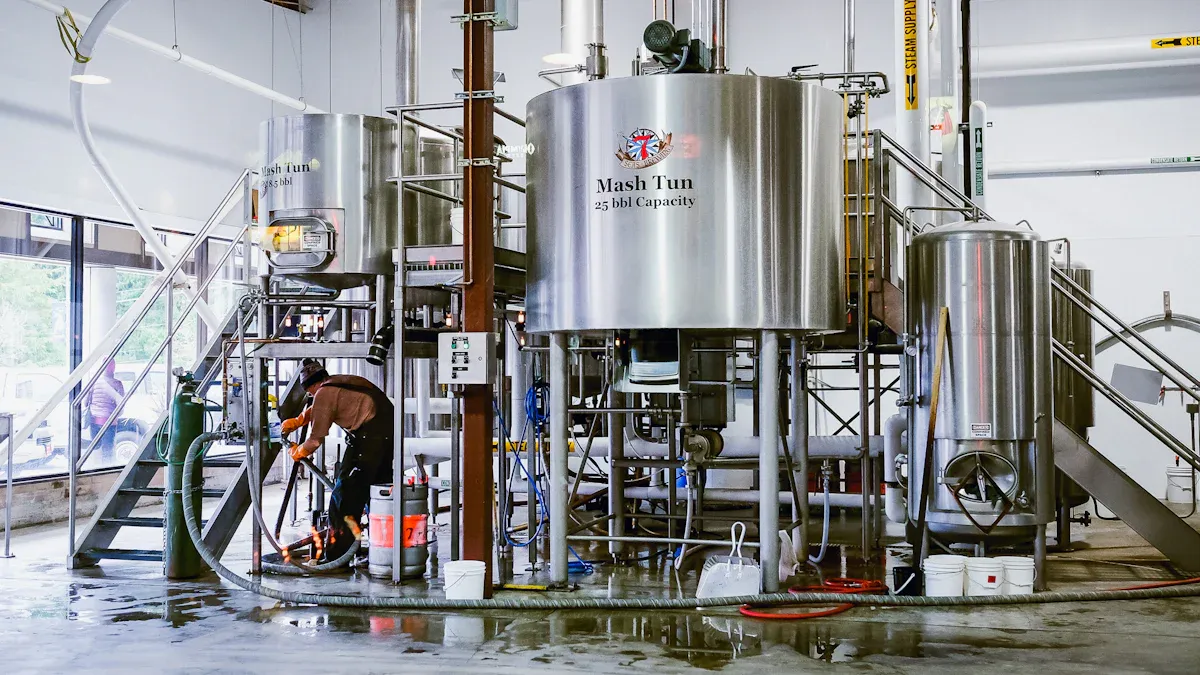
You need to prepare your distillery site before installing new equipment. Start by clearing the area where you plan to place your mash tun. Make sure the floor is strong enough to support the weight of the equipment. Check that you have enough space for workers to move around safely. Measure doorways and hallways to confirm that the equipment will fit through them. You should also look at your power and water connections. These must be close to the installation area. Good site preparation helps you avoid delays and keeps your distillery safe.
Tip: Take time to plan your layout. This makes future cleaning and maintenance easier.
Professional installation services help you set up your equipment correctly. You can work with experts who know how to handle brewing equipment. They will place your mash tun in the right spot and connect all the pipes and wires. These professionals check that everything works as it should. You save time and reduce the risk of mistakes. Many suppliers offer installation support. Ask your supplier if they provide this service. You get peace of mind when you let trained technicians install your equipment.
| Installation Step | Who Handles It | Why It Matters |
|---|---|---|
| Positioning Equipment | Professional Team | Ensures proper placement |
| Connecting Utilities | Certified Technician | Safe and reliable setup |
| Safety Checks | Installer | Prevents accidents |
After installation, you need to test and calibrate your equipment. Start by running water through the mash tun to check for leaks. Watch the temperature controls and make sure they respond quickly. Test the mixing system to see if it stirs the grains evenly. You should also check the drainage system. Make sure liquid flows out without clogging. Calibration helps you set the right temperature and mixing speed for your recipes. You want your equipment to work smoothly from the start.
Note: Keep a checklist during testing. This helps you catch any problems early.
You need proper training to operate your mash tun equipment safely and efficiently. Many suppliers offer guides and manuals that explain how to use each part of the equipment. You can find video tutorials that show step-by-step instructions for cleaning and maintenance. Some suppliers provide on-site training for your team. This helps everyone understand the best practices for running your distillery. You should keep a checklist for daily, weekly, and monthly tasks. This makes sure you do not miss important steps.
Tip: Ask your supplier for updated resources when new features or upgrades become available.
You can protect your investment by choosing a service agreement for your equipment. Service agreements often include regular inspections, emergency repairs, and access to spare parts. You get peace of mind knowing that experts will help you if something goes wrong. Support plans may offer phone or online assistance. You can contact technicians for advice about your distillery setup.
Here is a table showing common service agreement features:
| Feature | Benefit |
|---|---|
| Scheduled Maintenance | Keeps equipment running well |
| Emergency Support | Fast help when needed |
| Spare Parts Access | Quick replacement of parts |
| Technical Assistance | Answers to your questions |
You may face some common issues with mash tun equipment. You should learn how to spot problems early. If you notice uneven heating, check the temperature sensors and heating system. If the mixing system does not work smoothly, inspect the agitator for blockages. Drainage problems can happen if grains clog the outlet. Clean the equipment after each batch to prevent this.
Note: Keep a log of any issues you find. This helps you track patterns and share details with support teams.
You can solve many problems by following the supplier’s troubleshooting guide. If you need extra help, reach out to your support plan contact. Regular maintenance keeps your distillery running smoothly and helps you avoid costly repairs.
When you choose a mash tun distillery, you set the foundation for successful whisky production. You should focus on material durability, automation needs, certifications, and supplier support. The table below highlights what matters most:
| Key Factor | Description |
|---|---|
| Material Durability | Impacts taste, lifespan, and cleaning. Stainless steel is easy to maintain. |
| Automation Needs | Decide if you want manual or automated systems. Automation can save labor. |
| Certifications | Make sure your equipment meets safety standards like ASME and CE. |
| Supplier Inquiries | Ask about warranty, installation, training, and spare parts. |
You can make a confident purchase by comparing options and asking questions. If you want expert guidance, reach out to trusted suppliers like COFF. You will find support for every step of your whisky journey.
You should select a mash tun based on your batch size and future growth plans. Measure your production goals. Choose a vessel that fits your space and allows for expansion.
You need to clean your mash tun after every batch. Regular cleaning prevents residue buildup and keeps your whisky tasting fresh. Use warm water and a brush or spray system for best results.
Stainless steel works best for most distilleries. It resists corrosion, cleans easily, and lasts a long time. You get reliable performance and simple maintenance with stainless steel mash tuns.
You can automate many mash tun processes. Automation helps you control temperature, mixing, and cleaning. Automated systems save time and improve consistency in your whisky production.