


COPYRIGHT © 2022 COFF International Co., ltd. ALL RIGHTS RESERVED


Selecting the right nano brewing systems shapes your brewery’s success from day one. You may encounter challenges like:
By understanding these common hurdles, you can focus on how to choose nano brewing systems that fit your goals. A well-matched nano brewing setup ensures your brewing system delivers consistent results and supports your nano brewing ambitions.
You must understand your target market before you begin your nano brewery journey. Start by setting clear objectives for your market research. Identify who will buy your beer by looking at demographics, location, and interests. Study other breweries in your area to see what they offer and how they price their products. Watch for trends in craft beer styles and packaging. Use surveys and focus groups to learn what your future customers want. Analyze how other breweries distribute their beer, such as through bars, restaurants, or bottle shops. Make sure you know the rules for selling alcohol in your region. These steps help you build a strong foundation for your nano brewery setup.
Selecting the right beer styles and batch sizes shapes your brewing identity. Most nanobreweries produce less than 3 barrels per batch and keep annual production under 500 barrels. This small scale lets you experiment with new recipes and respond quickly to customer feedback. You can focus on local markets and direct sales, which often bring higher profit margins. Many successful nanobreweries use this flexibility to offer unique, seasonal, or experimental beers. This approach works well for experienced homebrewers, restaurant brewing, and those testing new ideas. A customized nano brewery setup allows you to adjust your brewing system as your business grows.
Setting clear goals guides your nanobrewery toward success. In the short term, you should:
For long-term success, you need to:
These core steps to build a nano brewery help you create a strong foundation. When you know how to start a nanobrewery, you can make smart choices at every stage. Follow these steps to start a nano brewery and set your business up for lasting success.
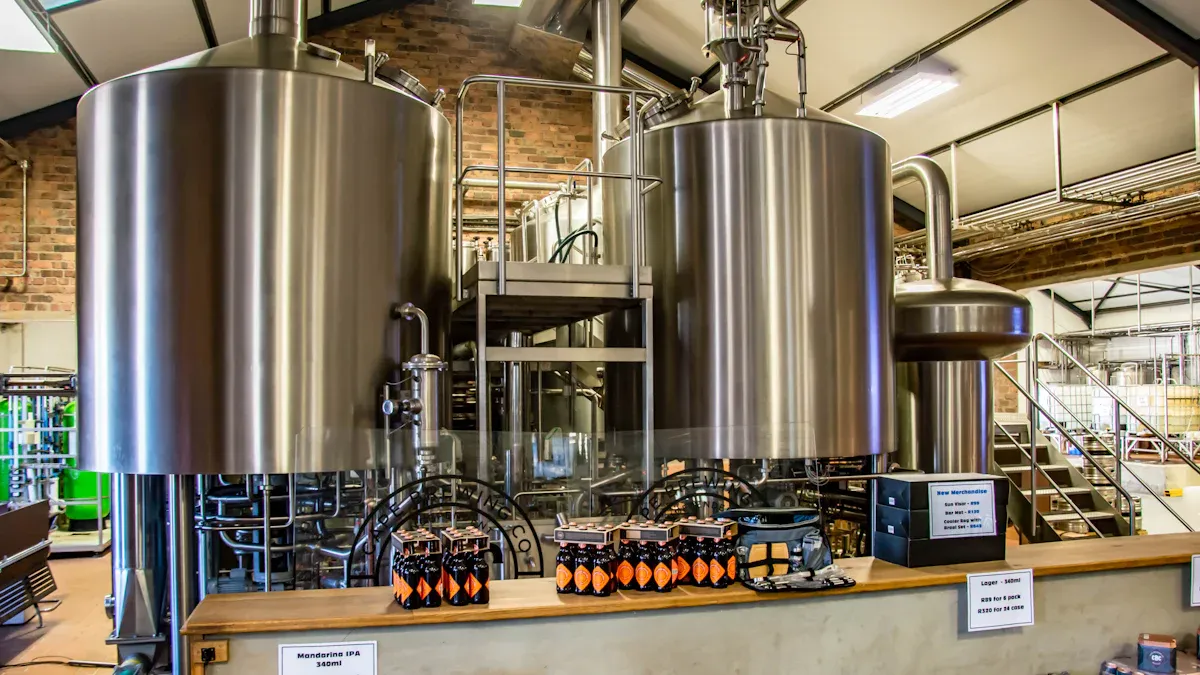
You need to measure your available space before you start your nano brewery setup. A basic nanobrewery requires at least 500 square feet, but most setups need between 800 and 1,000 square feet for production areas. This space covers the brewhouse, fermentation, and storage. If you plan to add a taproom, you should set aside at least 500 more square feet. The table below shows the minimum space needed for each area:
| Area Type | Minimum Space (sq ft) |
|---|---|
| Brewhouse | 200 |
| Fermentation | 300 |
| Storage | 200 |
| Taproom | 500+ |
You should always leave extra room for future expansion and safe movement around your brewing equipment.
A smart layout helps your nanobrewery run smoothly. You want to arrange your brewing equipment so you can move easily from one step to the next. Place your mash tun near your hot liquor tank to save time and effort. Keep raw materials, brewing, fermentation, and packaging areas separate. This setup reduces contamination risks and keeps your brewery clean. Use stainless steel tanks and multi-functional machines to save space. Automation, like PLC controllers and HMI touch panels, can make your brewing process more consistent and efficient. Always leave space for future upgrades or new equipment.
Tip: Design your nanobrewery so you can clean all areas easily and keep pathways clear for safety.
Your nano brewery setup needs strong utilities and good ventilation. You need water lines with 1-2 inch diameters and at least 40 PSI pressure. Most brewing equipment uses 208/240V three-phase electrical supply. If you use gas burners, plan for a heat load of 40,000-60,000 BTU per hour. Install a ventilation hood with at least 500 CFM airflow and aim for 8-12 air exchanges per hour. Bring in makeup air from outside to prevent negative pressure. Add carbon monoxide detectors and fire extinguishers for safety. Good ventilation removes steam, heat, and odors, keeping your nanobrewery safe and comfortable.
You must understand what drives the cost of your nano brewing system before making any investment. Several factors influence the final price you pay. The scale and production volume of your system play a major role. Larger tanks and higher capacity equipment increase the nano brewing brewery cost. The type of equipment matters as well. Manual systems usually cost less than automated ones, but automation can boost efficiency and profit in the long run. Material quality, especially high-grade stainless steel, adds to the price but ensures durability and sanitation. Brand reputation also affects cost, with established brands often charging more for reliability. Customization, extra features, and installation requirements further impact your budget considerations.
Tip: Always include installation, space modifications, and training in your cost analysis to avoid surprises.
You need to balance your initial investment with ongoing operational expenses. The upfront nano brewing brewery cost includes equipment, installation, and initial inventory. Ongoing costs cover utilities, raw materials, licensing, and payroll. The table below shows how these expenses compare:
| Cost Category | Upfront Investment Range | Ongoing Operational Costs Range |
|---|---|---|
| Equipment | $10,000 – $50,000 | N/A |
| Startup Total Costs | $20,000 – $95,000 | N/A |
| Utility Infrastructure & Installation | $20,000 – $100,000 | $8,000 – $30,000 per month |
| Raw Materials Initial Inventory | $3,000 – $10,000 | $15,000 – $50,000 per month |
| Licensing & Permits | $1,000 – $5,000 | Several thousand dollars annually |
| Staff Hiring & Training | $50,000 – $200,000 | Included in ongoing payroll |
| Marketing & Branding | $2,000 – $10,000 | 12-20% of gross revenue (first year) |
| Working Capital | $100,000 – $150,000 | Covers first few months of operations |
You should perform a thorough cost analysis to ensure your business remains profitable. Ongoing costs, such as utilities and raw materials, can match or even exceed your initial investment over time. Careful budget considerations help you maintain a healthy profit margin.
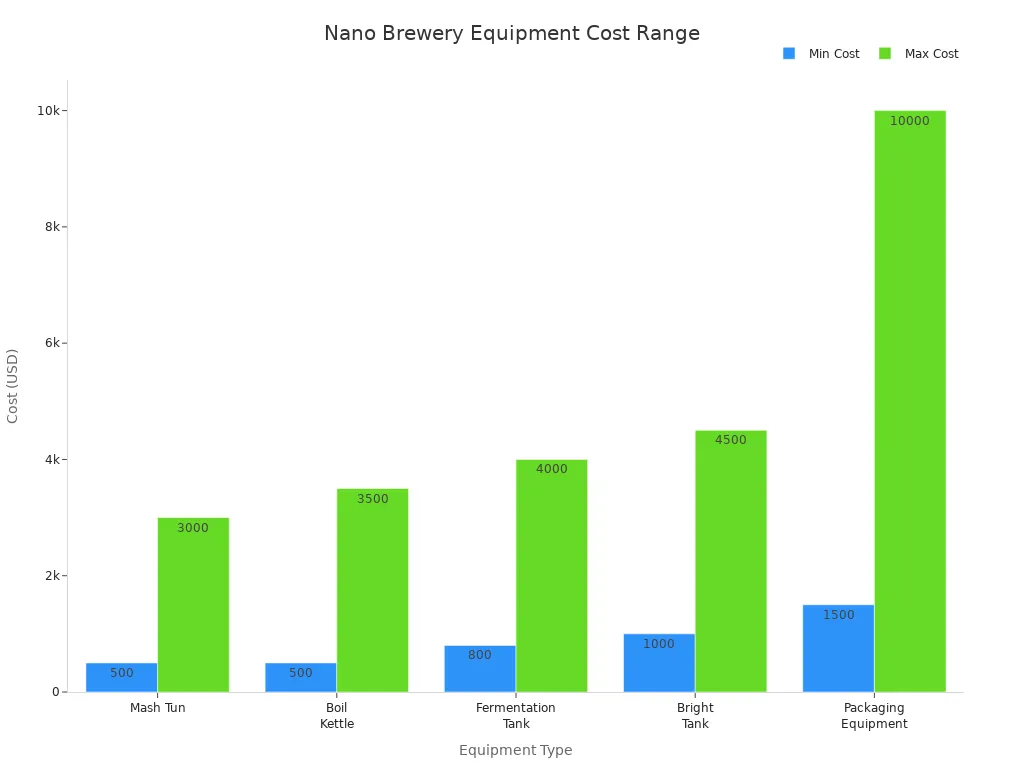
Installation and training are essential parts of your budget. Many new brewers overlook these expenses, but they can affect your timeline and profit. The average total cost to purchase and install a nano brewing system in 2024 ranges from $50,000 to $150,000. This figure covers equipment for production volumes of 100-500 barrels per year, including brewhouse components, fermentation tanks, cooling systems, and packaging. The chart below shows the cost range for each major equipment type:
You should also budget for staff training to ensure safe and efficient operation. Proper training reduces mistakes and supports consistent beer quality, which leads to higher profit. When you plan for installation and training, you set your brewery up for long-term success.
When you explore nano brewing system types, you will find two main options: all-in-one and modular systems. Each offers unique benefits for your nanobrewery system. The table below highlights the key differences:
| Aspect | All-in-One Nano Brewing Systems | Modular Nano Brewing Systems |
|---|---|---|
| System Design | Integrated, compact units with heating elements, pumps, and temperature controls for automated brewing | Separate components (kettles, lauter tuns, fermenters, accessories) allowing customization and expansion |
| Performance | Simplified, automated process with pre-programmed recipes; minimal manual labor; ideal for small batches (1-5 gallons) | More flexible and customizable; requires more brewing skill and manual intervention; scalable production capacity |
| Scalability | Limited to small batch sizes; fixed capacity | Allows gradual scaling by adding components and expanding capacity |
| Cost Structure | Lower startup cost; prices range from a few hundred to a few thousand dollars depending on automation and capacity; compact footprint | Higher initial cost due to multiple components; phased investment possible; additional costs for expansion modules and accessories |
| Automation Level | High automation, suitable for beginners | Partial or manual control, requiring more expertise |
| Space Requirements | Compact, typically under 4 sq ft | Requires more space as modules are added |
| Manual Labor | Minimal | More hands-on monitoring and manual labor required |
Note: All-in-one systems offer lower startup costs and simplified operation, making them ideal for beginners and small-scale production. Modular systems provide flexibility and scalability but involve higher initial investment and require more brewing knowledge.
If you have limited space or want to start small, an all-in-one nano brewing system fits well. If you plan to grow your nanobrewery system over time, modular systems allow you to add tanks and accessories as your production increases.
You must also decide between manual, semi-automated, and automated nano brewing system types. Each option affects labor, consistency, and investment. The table below compares these systems:
| System Type | Labor Savings | Consistency and Quality Control | Additional Notes |
|---|---|---|---|
| Manual | Requires significant human labor; high labor costs | High variability due to manual intervention | Labor-intensive; prone to human error and inconsistency |
| Semi-Automatic | Moderate labor savings; still requires multiple operators (4-6 for 1,000 BPH) | Filling variations ±2-3%; human factors cause inconsistencies | Suitable for small/craft breweries; flexible for small batches; lower upfront cost |
| Fully Automatic | Greatest labor savings; minimal operators needed (2-3 for equivalent output) | High precision ±0.5% fill accuracy; integrated quality checks | High capital investment; complex maintenance; best for large-scale, high-volume production |
Manual brewing systems require you to monitor every stage, from mashing to packaging. This approach demands more time and skill but gives you full control. Semi-automated systems reduce manual tasks and improve consistency, making them a good fit for small breweries that want flexibility. Automated brewing systems deliver the highest efficiency and product consistency. These systems use advanced controls to manage temperature, timing, and quality checks. You need less labor, but the initial investment is higher.
Tip: If you value flexibility and hands-on brewing, choose a manual or semi-automated system. If you want to maximize labor savings and consistency, automated systems offer the best results.
When you research how to choose a nano beer system, you should compare leading brands and their unique features. NingBo COFF Machinery Co., Ltd stands out as a top designer and manufacturer of high-quality nano brewing systems. COFF pioneered the oil-heated brewhouse and focuses on customer-oriented research and development. Their brewing system designs use world-class stainless steel and advanced automation, supporting both beginners and experienced brewers.
COFF’s nanobrewery system lineup includes both all-in-one and modular options. You can select compact, automated systems for small spaces or modular setups for future expansion. COFF’s equipment meets strict quality and safety standards, making it a reliable choice for breweries worldwide.
Other respected brands in the nano brewing system market also offer a range of system types. When you compare brands, look for:
Note: Choosing the right nanobrewery system brand ensures your brewing system supports your current needs and future growth.
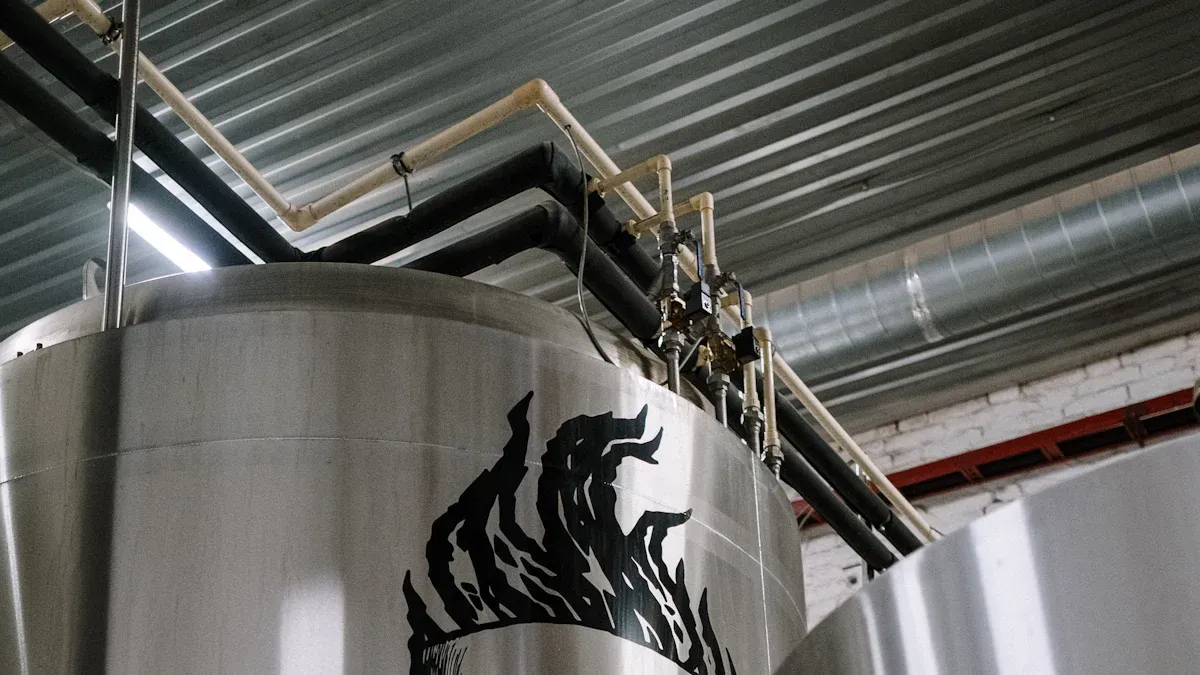
You should always check the quality of stainless steel when selecting nano brewery equipment. Stainless steel forms the backbone of most craft beer brewery equipment because it resists corrosion, stands up to high temperatures, and does not react with beer. The table below shows the most important quality indicators for stainless steel used in nano brewing systems:
| Quality Indicator | Explanation |
|---|---|
| Corrosion Resistance | Protects against moisture, acidity, and brine, ensuring long-lasting equipment. |
| Durability | Handles high temperatures and pressure without deforming. |
| Ease of Cleaning & Sanitizing | Smooth, nonporous surfaces make cleaning simple and prevent contamination. |
| Resistance to Temperature Fluctuations | Withstands rapid heating and cooling cycles, which are common in brewing. |
| Non-reactivity | Does not affect beer flavor or clarity, keeping your product consistent. |
| Stainless Steel Grades | 304 is standard; 316 offers extra protection, especially in harsh environments. |
| Maintenance & Cleaning | Use mild detergents and avoid bleach to protect the steel’s surface. |
| Welding Quality & Material Compatibility | Proper welding and matching materials prevent leaks and contamination. |
Choosing nano brewing systems with high-quality stainless steel ensures your brewing equipment lasts longer and keeps your beer safe.
A fully functional nano brewery equipment setup includes several key components. You need each part to maintain quality and efficiency in your brewing process. Here is a checklist to guide you:
You should also look for a malt milling unit, insulated glycol tanks, and reliable control cabinets. Each piece of craft beer brewery equipment plays a role in producing consistent, high-quality beer.
Safety and compliance must guide your choices when you buy nano brewery equipment. You need to ensure all brewing equipment meets local and international standards for food safety and electrical systems. Look for features like pressure relief valves, sanitary fittings, and easy-to-clean surfaces. Proper labeling and documentation help you pass inspections and keep your brewery running smoothly. Always follow recommended cleaning and maintenance routines to protect both your equipment and your staff. High-quality nano brewing systems support safe, reliable brewing and help you meet every regulation.
You should always start by checking the reputation of brewery equipment manufacturers. A strong reputation shows that the company delivers reliable nano brewery equipment and stands behind its products. Use the table below to guide your evaluation:
| Criteria Category | Key Evaluation Points |
|---|---|
| Reputation and Track Record | Years of experience, number of breweries supplied, referrals |
| Offering Suitability | Fit of standard packages, flexibility, customization options |
| Quality and Lead Time | Material quality, manufacturing checks, warranty, delivery times |
| Order Fulfillment and Shipping | Responsiveness, handling of shipping issues |
| Installation and Commissioning | Installation supervision, operator training, documentation |
| Ongoing Service and Support | Response times, maintenance, troubleshooting, servicing costs |
You can also look for customer reviews and ratings online. Established brewery equipment manufacturers often have a proven track record and satisfied clients. Make sure the company offers customization to fit your production needs and budget. Reliable manufacturers balance price, features, and service to help you get your nanobrewery turnkey solution.
Support and warranty services play a big role in your long-term success. Leading manufacturers provide technical support, project solutions, and on-site installation. You should expect:
Good support helps you get your nanobrewery turnkey solution up and running smoothly. Quality control during production and strict inspection records ensure your craft beer brewery equipment meets high standards. Always check the warranty coverage and after-sales service before you buy.
Easy access to spare parts keeps your nano brewery equipment running with minimal downtime. Many top brands source parts locally and offer dedicated replacement parts pages. You should:
Quick access to parts and responsive service help you maintain quality and avoid production delays. When you plan for spare parts, you protect your investment and keep your brewing equipment in top shape.
You can future-proof your nanobrewery by choosing a modular nano brewing system. Modular upgrades let you expand your brewery step by step. Many nano brewing systems offer compact malt mills with adjustable grinding, mash tuns with heating and stirring, and kettles with precise temperature control. You can add plate coolers, stainless steel fermentation tanks with pressure gauges, and automatic cleaning systems. Control panels often feature touch screens and remote monitoring. These upgrades help you adjust your process, boost capacity, and improve automation as your nano brewery grows.
| Modular Upgrade Area | Typical Features and Benefits |
|---|---|
| Malt Mills | Adjustable coarseness for recipe flexibility |
| Mash Tuns & Kettles | Integrated heating, stirring, and temperature control |
| Fermentation Tanks | Temperature control, pressure gauges, sight glasses |
| Cleaning Systems (CIP) | Automatic, flexible cleaning for frequent small batch production |
| Control Systems | PLC/PID automation, touch screens, Wi-Fi monitoring |
| Packaging & Cooling | Expandable pumps, packaging gear, and cooling systems |
Tip: Modular design lets you add new features without replacing your entire nanobrewery setup.
When your nanobrewery faces higher demand, you need a clear plan. Start by updating your permits and licenses to match your new production goals. Secure funding through loans, investors, or equipment leasing. Expand your distribution by working with wholesalers or offering new packaging like cans and kegs. Optimize your batch scheduling by using staggered fermentation and double batching. Invest in lab tools to keep your beer quality high. Grow your team, cross-train staff, and automate tasks like cleaning. Pre-sell batches to secure buyers and test demand with small runs. Right-size your equipment to avoid bottlenecks and budget for higher utility costs. Use your scale to improve marketing and connect with new customers.
Your nanobrewery can stand out by introducing new beer styles. Nano brewing systems support small batch sizes, so you can experiment with recipes and ingredients without much risk. You control temperature and pressure, which helps you fine-tune flavors. Many breweries use nano brewing systems as test setups for new styles before scaling up. You can switch between beer styles quickly and respond to trends. This flexibility encourages creativity and helps you build a unique brand in the craft beer market.
Before you make your final decision, check that your nano brewing system matches your goals and fits your space. Start by measuring your available area and planning your layout. Make sure your equipment will fit and allow for safe movement. Think about your target production volume and choose tanks and fermenters that support your brewing needs. Review local regulations and licensing to ensure compliance. Consider your brewing methods and beer styles when selecting equipment. Custom solutions can help you use your space efficiently and maintain high quality. Always leave room for future expansion. Professional installation and vendor support can help you get started smoothly.
You need to look beyond the initial price tag. The total cost of ownership includes many factors that affect your profit and long-term success. Consider the materials used in your equipment, such as stainless steel, which improves quality and durability. Automation can raise upfront cost but increases efficiency and consistency. Installation, facility upgrades, and training add to your expenses. Delivery and setup can also impact your budget. After-sales support, maintenance, and spare parts help you protect your investment and keep your brewery running. Always balance cost and quality to avoid hurting your profit or beer quality.
Tip: Installation costs can take up a large part of your budget, sometimes up to 25%. Plan for hidden expenses like plumbing, ventilation, and training.
Support and warranty play a big role in your brewery’s success. Review warranty terms and service options before you buy. Reliable support helps you solve problems quickly and keeps your equipment in top shape. Ask about technical support, training, and spare parts availability. Good support protects your profit by reducing downtime and keeping your beer quality high. Consult with other brewers who use the same equipment to learn about their experiences. Understand lead times and delivery logistics so you can plan your opening. Develop a training plan for your team to ensure safe and efficient operation.
A strong support system and clear warranty terms help you maintain quality and protect your profit as your brewery grows.
Choosing the right nano brewing system shapes your brewery’s future. You should:
A careful, informed approach helps you build a brewery that meets today’s needs and supports future growth.
You should choose a batch size between 1 and 3 barrels. This range lets you experiment with recipes and respond quickly to customer demand. Smaller batches also help you control quality and reduce waste.
You need at least 500 square feet for basic production. If you plan to add a taproom or expand, set aside more space. Always measure your area and plan your layout before buying equipment.
Stainless steel works best for nano brewing systems. It resists corrosion, cleans easily, and keeps your beer safe. Look for equipment made from 304 or 316 stainless steel for the best results.
Yes, you can upgrade most modular nano brewing systems. Add tanks, automation, or new features as your production increases. Modular designs help you expand without replacing your entire setup.
You should expect technical support, installation help, and training. Good manufacturers offer clear manuals, spare parts, and warranty coverage. Reliable support keeps your brewery running smoothly and protects your investment.