


COPYRIGHT © 2022 COFF International Co., ltd. ALL RIGHTS RESERVED


You need to choose brewery fermentation tanks that fit your brewing scale and your goals. If you brew at home, a smaller fermentation tank works best for your space and batch size. For commercial brewing, you need larger tanks to meet demand. You should know the difference between home and commercial brewing equipment before you decide. COFF gives you access to high-quality brewery fermentation tanks for both home and commercial brewing. With the right fermentation tank, you can make your brewing process smooth and efficient.

When you start home brewing, you will notice that most homebrewing fermenters come in a 5-gallon size. This size has become the standard for home brewing equipment. You can find smaller fermenters, like 1-gallon or 3-gallon vessels, which work well for experimenting or brewing small batches at home. Some homebrewers use larger fermenters, up to 13 gallons, if they want to make more beer at once. The size of your fermenter decides how much beer you can make in one batch. For example, a 5-gallon fermenter gives you about 5 gallons of finished beer. Studies show that the size of your fermenter does not change the taste or quality of your beer. You can focus on choosing a size that fits your space and your brewing goals at home.
You have several choices when it comes to materials for homebrewing fermenters. Stainless steel is the most popular option for home brewing equipment. It is strong, resists rust, and is easy to clean. Many homebrewers like stainless steel because it lasts a long time and keeps your beer safe from contamination. Plastic fermenters are also common in home brewing. They cost less and are easy to handle, but they can scratch and may not last as long. Glass fermenters are another choice for homebrewing. They do not scratch easily and are easy to clean, but they can break if you drop them. Some homebrewers use wooden barrels for special beer fermentation projects, but these are rare for small-scale brewing at home.
Tip: Always choose home brewing equipment that matches your cleaning habits and storage space. Stainless steel fermenters from COFF offer durability and easy maintenance for homebrewing.
Here is a quick comparison of common materials for homebrewing fermenters:
| Material | Advantages | Disadvantages |
|---|---|---|
| Plastic | Affordable, lightweight, easy to clean | Scratches easily, less durable |
| Stainless Steel | Durable, rust-resistant, easy to sanitize | Higher cost |
| Glass | Does not scratch, easy to clean | Breakable, heavier |
| Wooden Barrels | Adds unique flavors, traditional look | Hard to maintain, rare for home brewing |
COFF provides high-quality home brewing equipment, including stainless steel tanks designed for homebrewing. You can trust COFF to help you find the right fermenters for your home brewing needs.
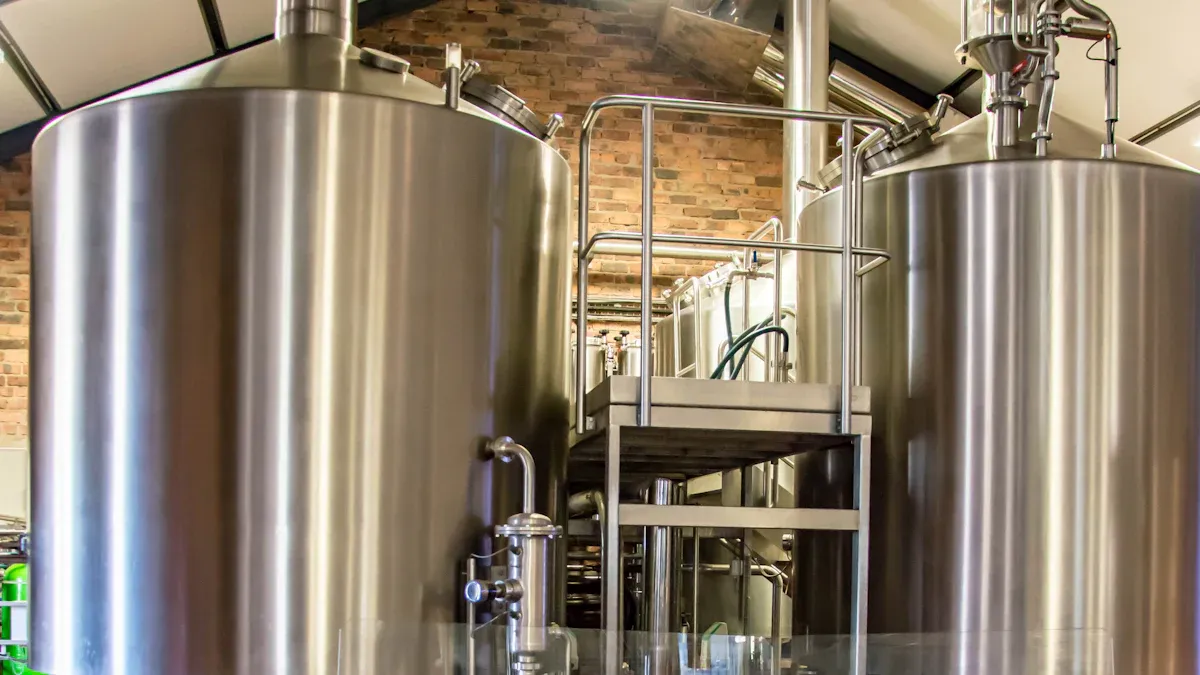
When you move into commercial brewing, you need much larger fermentation tanks than you use at home. Commercial brewing equipment supports higher production, so you can meet the needs of your customers. You will find that commercial brewing fermenters come in many sizes. Some tanks hold just 1 barrel (31 gallons), while others can hold over 1,000 barrels (31,000 gallons). This wide range lets you choose the right size for your production goals.
Here is a table that shows how commercial brewing equipment compares to home brewing:
| Brewery Scale | Typical Tank Size Range |
|---|---|
| Homebrewing | 5 to 15 gallons (19 to 57 liters) |
| Nano Brewery | 1 to 3 barrels (117 to 350 liters) |
| Microbrewery | 7 to 15 barrels (820 to 1,750 liters) |
| Regional Brewery | 30 to 100 barrels (3,500 to 11,700 liters) |
| Large Commercial | 200+ barrels (23,400+ liters) |
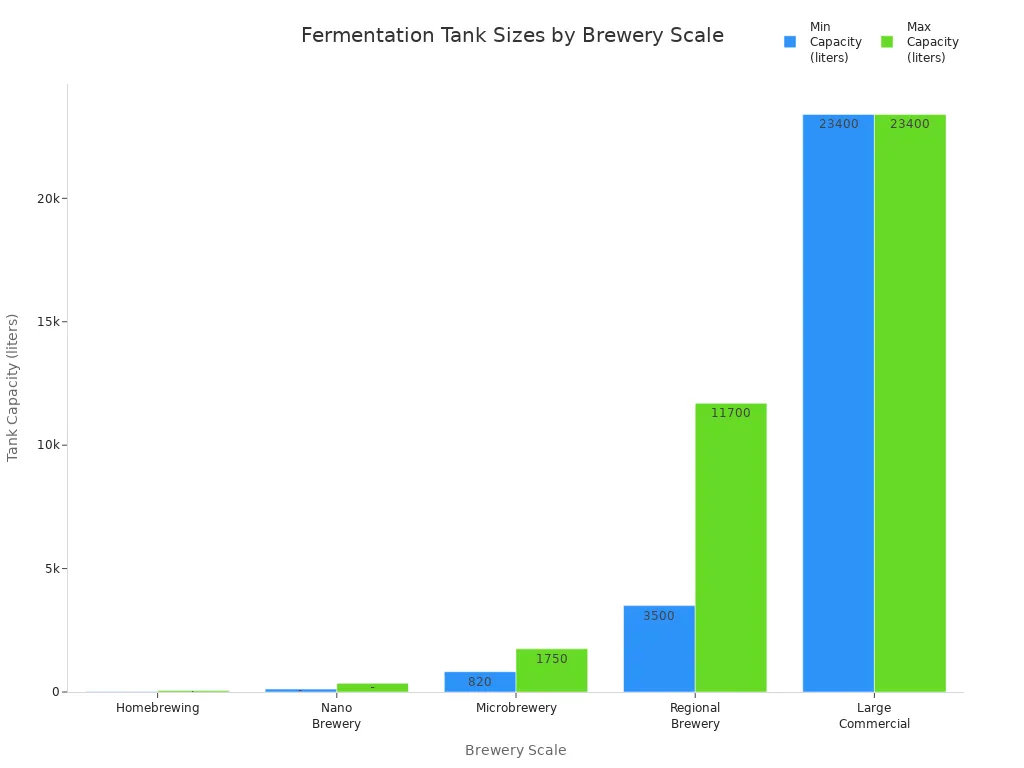
Commercial brewing fermenters help you scale up your production. You can brew more beer in less time, which is important for commercial breweries that want to grow. COFF offers commercial brewing equipment that fits every stage of production, from small craft operations to large-scale breweries.
You need advanced control features to get the best results from commercial brewing equipment. These controls help you manage every part of the brewing process. With commercial brewing fermenters, you can set and hold the perfect temperature for yeast activity. This keeps your beer consistent and high in quality.
Some of the most important control features in commercial brewing equipment include:
These technological innovations make commercial brewing more reliable and efficient. Advanced temperature control systems help you create the same flavor in every batch. You can also try new brewing styles and keep your production safe from contamination. COFF’s commercial brewing equipment uses the latest technological innovations to help you reach your production goals.
You will notice big differences in equipment complexity when you compare home brewing and commercial brewery fermentation tanks. Home brewing setups use simple tools. You might have a mash tun, a basic fermentation tank, and a few manual devices for cooling and filtering. These systems let you experiment and learn without needing advanced skills.
Commercial brewery fermentation tanks use much more complex systems. You will see automated temperature controls, glycol jackets, and programmable logic controllers. These tanks connect to larger brewhouse systems, filtration units, and packaging lines. You need to manage many steps, such as yeast handling, precise temperature control, and automated cleaning. Most commercial breweries hire skilled technicians to run these systems and keep the brewing process consistent.
Here is a table that shows the main differences in design and function:
| Aspect | Home Brewing Fermentation Tanks | Commercial Brewery Fermentation Tanks |
|---|---|---|
| Size | Small batches (5-10 gallons) | Large scale (hundreds to thousands of gallons) |
| Material Composition | Food-grade plastic (polyethylene, PET) or glass | Stainless steel (types 304 and 316L) |
| Temperature Control | Manual methods: water baths, refrigerators with controllers | Automated systems: glycol jackets, heat exchangers, automated monitoring |
| Cleaning & Sanitation | Basic cleaning with bleach or detergents; delicate handling due to material sensitivity | Rigorous cleaning with highly corrosive materials; daily sanitation protocols |
| Cost | Relatively low setup cost ($300-$500); manual equipment | Capital-intensive; tanks cost $2,000-$10,000+; higher operational costs |
| Design Focus | Versatility, experimentation, flexibility, low financial risk | Efficiency, consistency, large-scale production, automation |
| Functional Goal | Convert wort to beer with manual control, allowing recipe variation | Consistent product quality and flavor with automated precision |
You can see that home brewing tanks focus on flexibility and low cost. Commercial brewery fermentation tanks focus on efficiency, automation, and large-scale production. COFF offers both simple and advanced fermentation tank designs to match your brewing needs.
Cleaning and sanitation play a huge role in both home and commercial brewing. You must keep your fermentation tank clean to avoid contamination and protect the quality of your beer. Home brewers usually clean tanks with bleach or mild detergents. You need to handle plastic and glass tanks carefully because they can scratch or break. Cleaning takes less time, but you still need to follow a regular schedule.
Commercial brewery fermentation tanks require strict cleaning and sanitation routines. You will use powerful cleaning agents and automated Clean-in-Place (CIP) systems. These systems spray cleaning solutions inside the tank, reaching every corner and weld. You must follow daily cleaning protocols to prevent biofilm, yeast, and bacteria from building up. If you skip steps, you risk cross-contamination and off-flavors in your beer.
Here are some common cleaning and sanitation challenges you might face:
You will find that cleaning and sanitation take more time and effort as your brewing scale grows. COFF designs brewery fermentation tanks with easy cleaning and maintenance in mind, offering features that help you keep your equipment in top shape.
You will find that home brewing equipment offers a wide range of options to fit your budget. The cost of a basic setup stays low, which makes it easy for you to start brewing at home. If you choose glass or plastic fermenters, you can expect to pay between $50 and $500, depending on the size. These materials help keep the cost down, but they may not last as long as other options. Stainless steel fermenters give you better durability and sanitation, but the cost rises quickly. For a 5-gallon stainless steel fermenter, you might pay $150 to $300. Larger or more advanced tanks can cost up to $4,000, which makes them less accessible for many hobbyists. The table below shows how the cost changes with size and material:
| Size/Capacity | Material | Average Price (USD) |
|---|---|---|
| 5 Gallons | Glass | $50 – $100 |
| 5 Gallons | Stainless Steel | $150 – $300 |
| 50 Gallons | Plastic | $300 – $500 |
| 50 Gallons | Stainless Steel | $1,000 – $2,500 |
| 500 Gallons | Stainless Steel | $5,000 – $10,000 |
You can see that home brewing equipment stays affordable for small batches, but the cost increases with size and quality. Many beginners start with lower-cost options and upgrade as they gain experience. COFF offers a range of home brewing equipment, so you can find a solution that matches your budget and brewing goals.
Home brewing equipment stands out for its simple design and easy handling. You can manage most home brewing tasks without special training. Here are some features that make home brewing equipment easy to use:
You do not need advanced tools or complex systems to get started. You can brew in your kitchen, basement, or garage with just a few pieces of home brewing equipment. COFF designs home brewing equipment with user-friendly features, so you can enjoy brewing without stress.
You need to plan carefully for the investment in commercial brewing equipment. The cost of fermentation tanks can vary a lot. Small tanks for commercial brewing start under $5,000, while large tanks can go over $15,000. Many factors affect the total cost, such as the size of your brewery, the type of beer you want to make, and the level of automation you choose. Used equipment can lower your upfront cost by up to 60%. Custom features or higher automation can increase your investment by 10–50%. The country where you buy your equipment also matters. Domestic tanks often cost more but offer better support and quality. COFF provides a range of commercial brewing equipment to fit your budget and production needs.
| Aspect | Details |
|---|---|
| Typical Cost Range | $2,000 to $20,000 per fermentation tank |
| Small Tanks (3–5 BBL) | Under $5,000 |
| Large Tanks (20+ BBL) | Over $15,000 |
| Influencing Factors | Brewery size, production capacity, beer type, automation, new vs. used, country, customization |
| Cost Impact Examples | Automation can increase cost by 10–50%; used equipment reduces cost by 30–60% |
Tip: You can talk to COFF for help choosing the right commercial brewing equipment for your production goals and budget.
Automation brings many benefits to commercial brewing. You can control temperature, timing, and other brewing steps with high precision. Automated systems help you make more beer in less time and keep your product quality consistent. You also save on labor because machines handle many tasks for you. Here are some ways automation helps in commercial brewing:
COFF uses technological innovations to design commercial brewing equipment that supports automation. You can trust COFF to help you boost your production and keep your costs under control.
You want consistency in every batch when you practice homebrewing. Consistency means your beer tastes the same each time you brew. Many homebrewers face challenges with consistency because small changes can have a big impact on beer quality. Temperature swings, poor sanitation, and yeast health all affect consistency in product. Fermentation tanks play a key role in this process.
Here is a table showing common consistency issues and how fermentation tanks contribute:
| Consistency Issue | Explanation | Fermentation Tank Contribution |
|---|---|---|
| Inconsistent Temperatures | Temperature swings stress yeast and change flavors. | Tanks must provide steady temperature control for reliable fermentation. |
| Slow Fermentation | Weak yeast or wrong temperature slows fermentation. | Tanks with valves help reduce oxygen exposure and support healthy yeast activity. |
| Weak Flavors and Aromas | Poor yeast or contamination causes dull flavors. | Clean, well-controlled tanks help develop strong flavors. |
| Carbonation Problems | Errors in sugar or incomplete fermentation affect carbonation. | Tanks allow controlled carbonation but need proper use and maintenance. |
| Hygiene Problems | Poor cleaning leads to contamination and off-flavors. | Tanks require thorough cleaning to protect beer quality. |
You can improve consistency by keeping your fermentation tanks clean, controlling temperature, and using healthy yeast. Tanks from COFF help you maintain quality and consistency in every batch.
Flavor management is another important part of homebrewing. You control the flavor of your beer by managing fermentation temperature, yeast health, and tank conditions. Temperature control has a big impact on beer quality. If you keep the temperature steady, you help yeast produce the right flavors and avoid off-flavors.
You can use several methods to manage flavor during homebrewing:
When you use the right fermentation tank and control your process, you can create high quality beer with the flavors you want. COFF offers tanks designed for easy temperature control and cleaning, helping you achieve the best results in homebrewing.
You need precise control to produce high quality beer in a commercial brewing environment. Modern fermentation tanks use advanced systems to help you manage every part of the process. These features keep your product consistent and safe from spoilage.
Tip: COFF offers commercial brewing tanks with these precision features, helping you deliver consistent quality in every batch.
| Precision Control Feature | Description and Function |
|---|---|
| Temperature Control System | Maintains optimal fermentation temperature with high accuracy. |
| Pressure Control | Ensures stable conditions and prevents contamination. |
| Gas Control System | Regulates CO₂ and oxygen for proper fermentation. |
| Automated Cleaning System (CIP) | Reduces contamination risk and saves labor. |
| Agitation and Mixing Controls | Keeps fermentation uniform and yeast suspended. |
| Data Recording and Intelligent Control | Allows real-time monitoring and process management. |
| Materials and Surface Treatment | Uses polished stainless steel for easy cleaning and less bacteria. |
You must follow strict rules when you run a commercial brewery. These rules protect your staff, your customers, and your business. They also guide you in choosing the right fermentation tanks.
| Regulatory Requirement | Description | Impact on Fermentation Tank Equipment Selection |
|---|---|---|
| OSHA Confined Spaces | Tanks are confined spaces with gas risks. | Tanks need proper labeling, gas monitoring, and safe access. |
| Air Contaminants | CO₂ exposure limits apply. | Tanks must support ventilation and CO₂ monitoring. |
| Safety Signs | Warning signs are required. | Tanks and areas need clear hazard labels. |
| General Safety | PPE and emergency gear are needed. | Tanks must fit with safety equipment and emergency stations. |
| Confined Space Protocols | Training and rescue plans are required. | Tanks must allow safe maintenance and emergency access. |
COFF designs commercial brewing tanks to help you meet all these requirements. You can trust COFF to support your commitment to safety and quality.
You need to decide how much beer you want to make before you choose your homebrewing equipment. Batch size shapes your entire setup. If you brew small batches, like 1 to 5 gallons, you can use smaller fermenters such as 5-gallon buckets or glass carboys. These are easy to handle and cost less. Small batches also fit well in tight spaces, like kitchen counters or shelves. You can chill and clean these smaller vessels quickly, which makes homebrewing more manageable for beginners.
If you want to brew larger batches, you need bigger fermenters. A 10-gallon or larger stainless steel vessel gives you more capacity, but it takes up more room and costs more. Larger batches work best if you have experience and want to share your beer with friends or family. COFF offers a range of fermenters for every batch size, so you can find the right fit for your homebrewing goals.
Tip: Start with small batches if you are new to homebrewing. You can always scale up as you gain confidence.
You must plan your space and budget before you buy homebrewing equipment. Think about where you will clean, brew, and store your gear. A large stainless steel sink with a sideboard helps you clean and dry your vessels. Good ventilation is important, especially if you use gas burners. Try to keep your brewing area organized. Group your cleaning, brewing, and storage tasks together to save time and effort.
Here are some key points to consider:
COFF provides durable and efficient homebrewing equipment for every space and budget. Careful planning helps you enjoy homebrewing without stress.
You need to match your equipment to your production goals. Start by deciding how much beer you want to make each week, month, or year. Your batch size sets the minimum volume for each fermentation tank. If you plan to brew large batches, you need bigger tanks. If you want to brew several types of beer at once, you need more tanks.
Fermentation tanks stay full for 7 to 21 days, so you must plan for cleaning and downtime. Overlapping fermentation cycles help you keep beer flowing without delays. You may need extra tanks to avoid bottlenecks. The type of beer you brew also affects your choice. Some styles need special temperature controls or pressure ratings.
COFF offers a wide range of tank sizes and features. You can choose tanks that fit your space, budget, and future plans. COFF’s experts help you design a layout that supports your production targets and keeps your brewery running smoothly.
Tip: Always consider your long-term production needs. Planning ahead saves you money and time as your brewery grows.
You want equipment that grows with your business. Scalability means you can increase output without replacing all your gear. Look for features that support future expansion and efficiency.
COFF’s commercial brewing solutions include advanced automation, modular layouts, and smart controls. You can start small and expand as your production grows, knowing your equipment will keep up.
You may brew at home for fun, creativity, and the joy of sharing your own beer. Home brewing lets you control every detail, from alcohol content to aroma. You can experiment with different recipes and styles. Small fermentation tanks work best for this purpose. They save space, cost less, and make it easy to try new things. You can find tanks with features like temperature control and tight sealing. These help you make better beer and enjoy the process more.
Tip: Choose a tank that matches your space and how much beer you want to make. Enjoy the freedom to create your own flavors.
If you plan to grow a brewing business, your goals change. You need equipment that supports higher production, efficiency, and quality. Commercial brewing tanks must handle large batches and strict standards. You should look for tanks made from high-quality stainless steel with features like cooling jackets and strong valves. Automation and easy cleaning systems help you save time and keep your beer consistent.
| Brewing Ambition | Typical Scale | Equipment Focus | Automation Level | Cost Implication |
|---|---|---|---|---|
| Personal Enjoyment | Small/home batches | Compact, flexible, easy to use | Manual/Semi-automatic | Low to moderate |
| Business Growth | Commercial/large | Durable, scalable, automated, high performance | Fully automated | High |
Note: COFF supports both hobbyists and professionals. You can rely on COFF for expert guidance and equipment that matches your ambitions.
You want equipment that stands out for quality and reliability. COFF designs and manufactures brewery fermentation tanks using high-grade stainless steel. Each tank meets strict international standards, including ASME and AS1210 certifications. These certifications show that COFF products pass tough safety and quality tests.
COFF leads the industry with innovative technology. You benefit from IoT-enabled smart sensors and AI-driven automation in your tanks. These features let you monitor temperature, pressure, and fermentation activity in real time. You get consistent results and can control every step of your brewing process. Automated cleaning systems save you time and reduce labor costs. COFF also uses 3D printing to create custom parts quickly, so you experience less downtime. Sustainable designs help you save energy and support your environmental goals.
COFF’s global reputation comes from serving brewers in the U.S., Canada, the UK, Australia, Japan, and many other countries. Most customers recommend COFF to others, and many build long-term partnerships. You can trust COFF to deliver tanks that help you brew with confidence.
You need support that matches your brewing ambitions. COFF offers a customer-oriented approach that makes your experience smooth and stress-free.
COFF’s service model meets and often exceeds industry standards. You get convenience, reliability, and expert advice at every stage. Whether you brew at home or run a commercial operation, COFF stands by your side with innovative solutions and dedicated support.
When you choose a fermentation tank, consider your production capacity, quality needs, features, space, and budget. Matching your tank to your brewing goals helps you avoid bottlenecks and maintain beer quality. Many breweries see better yield and fewer issues after upgrading to stainless steel tanks with advanced features. COFF offers reliable solutions for both home and commercial brewers. You can reach out to COFF for expert advice and equipment that fits your ambitions and supports your success.
Tip: The right tank choice leads to efficient brewing, consistent results, and long-term growth.
You should pick a tank that matches your batch size and storage space. Most home brewers use 5-gallon tanks. If you want to experiment, try smaller tanks. For bigger batches, choose a larger vessel.
You need to rinse your tank with warm water. Use a food-safe cleaner and a soft brush. Rinse again, then sanitize with a no-rinse sanitizer. Always follow the instructions for your tank’s material.
You cannot use most home brewing tanks for commercial brewing. Commercial brewing needs larger, certified tanks with advanced controls. COFF offers scalable solutions if you want to grow your brewing operation.
Look for stainless steel construction, precise temperature control, and easy cleaning systems. Automated features help you save time and improve consistency. COFF provides tanks with these advanced features for commercial brewers.