


COPYRIGHT © 2022 COFF International Co., ltd. ALL RIGHTS RESERVED


This ultimate checklist gives you a clear framework for your purchase. The craft spirits market is projected to grow over 28% annually, making smart choices essential for success. Your journey begins with a solid plan. You must evaluate several core pillars to select the right whisky distillery equipment.
Your Core Decision Pillars:
- Define Your Whisky Profile
- Select the Right Still
- Determine Capacity and Materials
- Plan for Utilities
- Create a Full Budget
- Vet Your Suppliers
Following this framework ensures you buy your whisky distillery equipment with confidence.
Key Takeaways
- Define your whisky’s flavor first. This choice helps you pick the right still for your spirit.
- Match your equipment size to your business plan. This prevents you from buying too small or too large.
- Choose copper for better flavor. Copper removes bad tastes from your whisky.
- Plan for all costs, not just the still’s price. Include shipping, installation, and utility upgrades.
- Pick a supplier with a good reputation. They should follow all safety rules and have happy customers.
DEFINE YOUR PRODUCT AND STILL
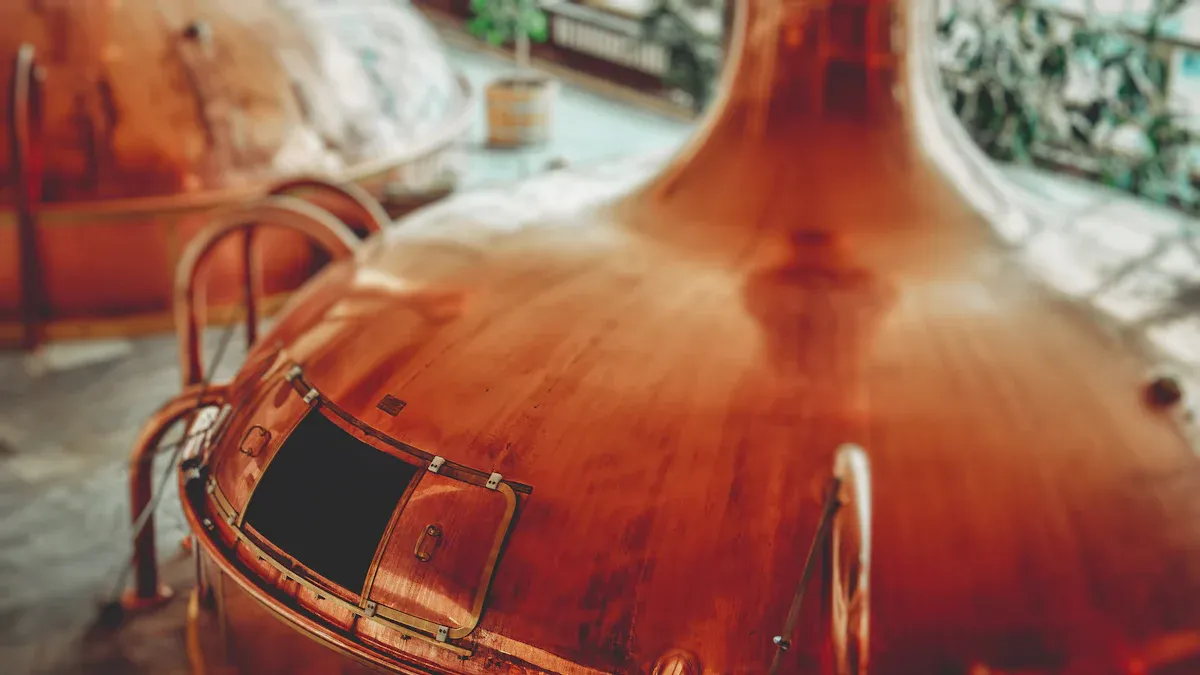
Your journey starts with a clear vision for your whisky. The type of spirit you want to create directly influences your choice of still. A full-bodied, flavor-rich whisky points toward one type of equipment. A lighter, cleaner spirit requires another. This decision is the most critical step in selecting your whisky distillery equipment.
ESTABLISH YOUR WHISKY PROFILE
You must first define your target flavor. Do you want a complex, heavy spirit with lots of congeners, like a traditional Scotch or Bourbon? Or do you prefer a lighter, more neutral spirit? Your yeast selection during fermentation plays a huge role here. Different yeast strains create the initial flavor compounds.
Yeast’s Impact on Flavor
- Non-Saccharomyces yeasts often produce higher levels of esters, creating fruity notes.
- Co-fermentation with different yeasts can improve yield and enhance specific flavors.
- Kveik yeast is a unique variant that contributes its own distinct character to the final spirit.
The still’s job is to capture or remove these flavors.
CHOOSE A POT STILL
You should choose a pot still for a flavor-driven whisky. Pot stills retain more congeners, which are the flavor and aroma compounds created during fermentation. A pot still has three main parts: the pot, the swan neck, and a lyne arm that connects to the condenser. The shape of these components dramatically impacts your final product. The lyne arm’s angle is especially important.
| Lyne Arm Angle | Reflux Effect | Spirit Character |
|---|---|---|
| Upward | Increases reflux, sending vapor back down. | Creates a lighter, more delicate spirit. |
| Downward | Reduces reflux, allowing more congeners through. | Produces a heavier, oilier spirit. |
CHOOSE A COLUMN OR HYBRID STILL
You should select a column or hybrid still for higher purity and efficiency. These stills are ideal for creating lighter whiskies, vodka, or gin. They use internal components like bubble plates and dephlegmators to refine the spirit in a single run.
- Bubble Plates force vapor to interact with liquid on each plate. This process creates multiple mini-distillations inside the column, stripping out heavier compounds and increasing the spirit’s proof and purity.
- A Dephlegmator is a partial condenser at the top of the column. It cools vapor, forcing some of it back down as reflux. This action allows you to precisely control the proof and make clean cuts between heads, hearts, and tails.
This level of control makes column and hybrid stills incredibly versatile pieces of equipment.
DETERMINE CAPACITY AND MATERIAL
After defining your spirit, you must decide on the size and material of your equipment. These choices connect directly to your business goals and budget. Getting this right prevents costly mistakes and prepares you for future growth.
ALIGN CAPACITY WITH YOUR BUSINESS PLAN
Your still’s capacity should match your five-year business plan. A small still limits production, while a large one wastes capital and energy. Your plan helps you find the right balance between current needs and future expansion. It forces you to ask critical questions about your long-term goals.
| Business Plan Aspect | How It Determines Still Size |
|---|---|
| Long-term Planning | A phased approach helps you grow gradually instead of overbuilding or underbuilding from the start. |
| Future Needs | You can anticipate how production requirements and space might change over five years. |
| Strategic Space | Your plan guides you to allocate space for future expansion, like doubling production capacity. |
| Capacity Evaluation | You assess sales projections and market demand to align equipment size with real-world goals. |
MATERIAL SELECTION: COPPER VS. STAINLESS
The material of your still directly impacts your whisky’s final flavor. Copper is the traditional choice for a reason. It chemically reacts with and removes undesirable sulfur compounds during distillation. This reaction is essential for creating a smooth, clean-tasting spirit.
Copper’s Chemical Magic ✨ Copper actively purifies your spirit by removing harsh flavors. For example, it reacts with hydrogen sulfide, which smells like rotten eggs, and forms copper sulfide. This solid compound precipitates out of the final distillate, leaving you with a better-tasting product.
Stainless steel is a durable and more affordable alternative. It is easier to clean and lasts a long time, but it does not provide the same flavor-purifying benefits as copper.
THE HYBRID MATERIAL STRATEGY
Many modern distillers choose a hybrid material strategy. This approach gives you the best of both worlds. You get the durability and cost-effectiveness of a stainless steel pot with the flavor-enhancing benefits of copper in key areas. This is a smart way to manage the cost of your whisky distillery equipment.
Key copper components in a hybrid still include:
- A Copper Helmet: The helmet provides more surface area. This design increases passive reflux, which helps create a purer, higher-proof spirit.
- Copper Column Internals: Copper acts as a catalyst for desirable reactions and resists corrosion from the acidic wash.
- A Copper Condenser: An efficient copper condenser ensures optimal vapor condensation and collection, completing the purification process.
PLANNING YOUR WHISKY DISTILLERY EQUIPMENT
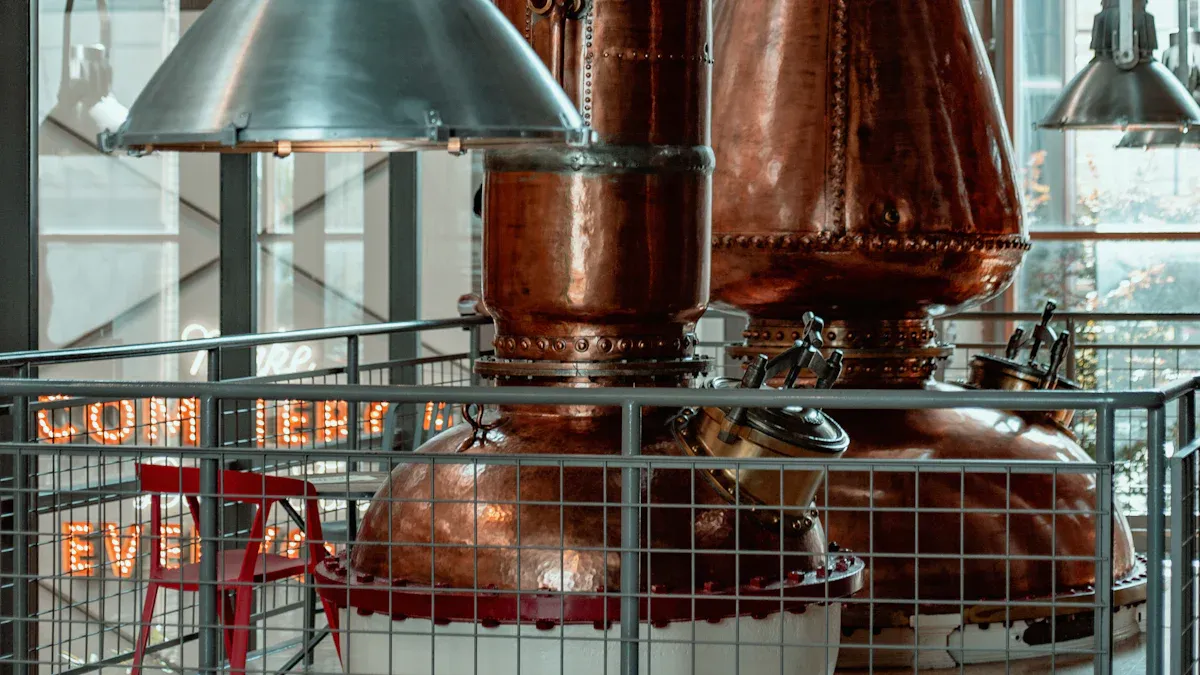
You must plan beyond the still itself. Your heating method, control system, and support equipment are critical for a functional distillery. These choices impact your daily operations, safety, and product quality. A good plan ensures all your whisky distillery equipment works together seamlessly.
SELECT YOUR HEATING METHOD
Your heating method affects efficiency, cost, and safety. You have three main options: direct fire, steam jackets, and electric. Each has unique infrastructure needs and operational costs.
- Direct Fire: This method uses a gas burner. It saves space because you do not need a separate boiler. However, gas heating is often less efficient.
- Steam Jackets: These systems use a boiler to circulate steam. They offer excellent heat transfer but require a significant investment in the boiler and piping.
- Electric: This option is highly efficient for smaller stills. It transfers nearly 100% of its energy as heat. The main drawback is a higher operational cost compared to steam.
You must also consider the installation requirements for each system.
| Requirement Category | Steam-Jacketed Still | Direct-Fire Gas Still |
|---|---|---|
| Infrastructure | Needs a boiler, pressurized jackets, and condensate returns. | Requires a gas line and may need an exhaust system. |
| Permits | Mandates costly permits and inspections for boilers. | Subject to emissions regulations for gas burners. |
| Safety | Involves managing high-pressure steam. | May require a fire suppression system in some buildings. |
CHOOSE YOUR CONTROL SYSTEM
A modern control system saves you time and money. Automation ensures your batches are consistent, which is vital for your brand. An automated system can manage recipes, control temperatures, and track production data. This reduces manual labor and minimizes human error. For example, integrating an Enterprise Resource Planning (ERP) system can save over 60 hours of manual work each month. Precise analytical instruments also help you create a consistent product every time.
IDENTIFY ANCILLARY EQUIPMENT
Your still needs a team of supporting equipment to function. You must budget for these essential items from the start. Your list should include:
- Mash Tuns
- Fermentation Tanks
- Pumps and Piping
- A Clean-in-Place (CIP) System
- A Reverse Osmosis (RO) Water System
- A Small Bottling Line
Why a CIP System is Essential 🧼 A Clean-in-Place (CIP) system automates the cleaning of your tanks and pipes. It prevents bacterial infections that can ruin your spirit’s flavor. A good CIP system also recycles cleaning solutions, which reduces water usage and lowers your operating costs. It is a key investment for quality and efficiency.
BUDGET AND SUPPLIER VETTING
You have a plan for your distillery. Now you need to create a budget and find the right partner to build it. This step is about making smart financial choices and vetting suppliers to ensure long-term success.
CALCULATE TOTAL COST OF OWNERSHIP
The price of the still is only one part of your budget. You must calculate the total cost of ownership to get a true financial picture. A complete budget for your whisky distillery equipment includes more than just the sticker price.
Your Complete Budget Checklist:
- The still and all ancillary equipment
- Shipping and freight charges
- Installation and commissioning fees
- Utility upgrades for water, power, and drainage
Forgetting these items can lead to major budget problems later.
BALANCE QUALITY AGAINST PRICE
You should balance equipment quality against its price. The cheapest option is rarely the best investment. Poorly made equipment can lead to costly repairs and inconsistent products. You can spot quality by looking at the details. For example, check the welds on the stainless steel vessels.
High-quality welds show good craftsmanship. Look for these signs:
- The weld line is smooth and straight.
- It has a uniform thickness with no dips or craters.
- The weld is free of purple or blue discoloration.
These details indicate a durable and reliable piece of equipment.
VET SUPPLIER REPUTATION
You must vet your supplier’s reputation carefully. Look for a manufacturer with a proven track record and happy customers. For example, a supplier like COFF Machinery has a strong reputation in the U.S., Canada, and Europe. A high percentage of their customers come from partner recommendations, which is a powerful sign of quality and trust. You should also look for an experienced engineering team and key certifications like ASME and AS1210. These prove the supplier meets high safety and manufacturing standards.
CONFIRM REGULATORY COMPLIANCE
Your supplier must understand and comply with all government regulations. In the United States, the Alcohol and Tobacco Tax and Trade Bureau (TTB) sets the rules. The TTB can require equipment manufacturers to provide the name and address of everyone who buys a still. Working with a supplier who knows these rules helps you avoid legal issues. A compliant partner ensures your operation starts smoothly and stays on the right side of the law.
You now have the definitive path for a successful equipment purchase. A thoughtful approach using this checklist sets your distillery up for long-term success. It helps you mitigate risks and make smart investments.
Your path to success includes:
- Profile & Still: Match your still to your desired whisky flavor.
- Capacity & Material: Align production scale and materials with your business plan.
- Utilities & Ancillaries: Plan for your heating, controls, and support systems.
- Budget & Supplier: Calculate total cost and vet partners for quality and compliance.
You now have the framework. Use this checklist to confidently engage with suppliers and build the distillery of your dreams.
FAQ
How long does it take to get distillery equipment?
You should plan for long lead times. Manufacturing and shipping custom equipment can take several months. A typical timeline ranges from 4 to 6 months, but you must confirm the exact schedule with your supplier. This ensures your project stays on track without unexpected delays.
Can I use a pot still for other spirits like gin?
Yes, you can adapt a pot still for gin production. Many suppliers offer a gin basket attachment. This component allows you to vapor-infuse botanicals into your neutral spirit, making your equipment a versatile asset for creating multiple products beyond whisky.
What is the most important certification for my equipment?
You must prioritize certifications for pressure vessels to ensure safety. Key certifications prove your equipment meets strict engineering and manufacturing standards.
- ASME (American Society of Mechanical Engineers) is critical in the U.S.
- AS1210 is the equivalent standard for Australia.
Do I need a boiler for a small distillery?
A boiler is not always necessary for a small setup. You can use direct-fire gas or electric heating systems for smaller stills. These options save significant space and help you avoid the high upfront cost and complex permits associated with steam boilers. 🔥