

COPYRIGHT © 2022 COFF International Co., ltd. ALL RIGHTS RESERVED


For homebrewers and commercial brewery operators focused on consistent quality, batch-to-batch reliability, and long equipment lifespan, stainless steel beer fermenters are the undisputed industry standard. Four core advantages set them apart from plastic and glass alternatives: superior hygiene, precise temperature control, exceptional durability, and stronger long-term value.

Fermentation is a sensitive biological process, and vessel material directly shapes four critical outcomes: microbial safety, oxygen exposure, temperature stability, and flavor neutrality.
Porous or easily scratched surfaces allow biofilms — sticky, resilient colonies of bacteria and wild yeast — to take hold. These hidden contaminants can ruin batches, cause off-flavors, and create persistent sanitation issues. Material also determines heat transfer efficiency, which dictates how tightly brewers can control fermentation temperature, the single biggest driver of yeast behavior and flavor compound production.
Plastic, glass, and aluminum all have notable limitations for fermentation: plastic scratches and becomes porous over time; glass is fragile and shatters on impact; aluminum oxidizes when exposed to acidic wort and oxygen-based cleaners. Stainless steel solves nearly all of these pain points, which is why it has become the default choice for professional breweries and serious homebrewers.

The smooth, non-porous surface of food-grade stainless steel is its biggest sanitation advantage. Bacteria, wild yeast, and organic residue cannot sink into the metal, and the material does not absorb flavors or odors from previous batches.
Unlike plastic, which develops micro-scratches that harbor biofilms even after sanitizing, stainless steel can withstand high-heat cleaning, harsh alkaline cleaners, and full clean-in-place (CIP) cycles without degrading. Conical fermenter designs further reduce contamination risk by minimizing gaskets and seam joints, each of which is a potential harborage point.
Integrated CIP systems with rotating spray balls take sanitation to a commercial grade:
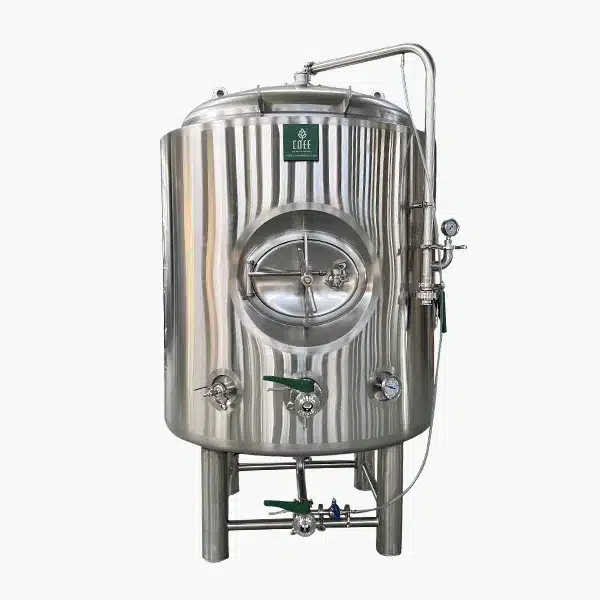
For example, COFF Beer Tanks are manufactured from 100% food-grade SUS304 stainless steel with full TIG welding for smooth, crevice-free seams that eliminate biofilm harborage points. All conical models come with integrated rotary spray ball CIP systems for efficient, consistent cleaning.
Fermentation temperature is the single most important process variable in beer brewing. It directly controls yeast activity, fermentation speed, and the production of flavor compounds like esters, diacetyl, and fusel alcohols. Even small temperature swings can produce harsh, solvent-like off-flavors or stall fermentation entirely.
Stainless steel’s uniform thermal conductivity makes it ideal for precision temperature control. High-quality conical fermenters use dual or triple dimple cooling jackets paired with 80mm polyurethane insulation to maintain stable temperatures across the entire vessel. PID control systems can hold temperature fluctuations within ±0.1°C, ensuring identical yeast performance batch after batch.
Additional material benefits:
Stainless steel forms a thin, self-healing chromium oxide layer on its surface that naturally resists rust and corrosion. Two grades are most common in brewing:
Compared to alternative materials:
COFF fermenters hold ASME and AS1210 pressure vessel certifications, with every unit passing full Factory Acceptance Testing and at least two operational trials before shipment to ensure structural reliability.
Stainless steel fermenters have a higher upfront cost than plastic buckets or carboys, but the math shifts dramatically over the long term.
For commercial operations, the reduction in lost batches and labor costs usually pays back the price premium within a few years. For homebrewers planning to stay in the hobby long-term, a single stainless conical often costs less over a decade than replacing plastic buckets every 1–2 years.
| Category | Stainless Steel | Plastic (PET/Bucket) | Glass Carboy |
|---|---|---|---|
| Hygiene | Excellent; non-porous, no biofilm risk | Poor; scratches harbor bacteria | Good; non-porous but hard to clean fully |
| Temperature control | Excellent; jacketed for precise cooling | Poor; no insulation, high temperature swing | Poor; no temperature control capability |
| Durability | Extremely tough; impact and corrosion resistant | Scratches easily; degrades over time | Very fragile; shatters on impact |
| Lifespan | 15–30+ years | 1–5 years | 5–10 years with careful handling |
| Upfront cost | Higher | Lowest | Low |
| Best for | Commercial breweries, serious homebrewers, long-term use | Casual homebrewers, budget setups | Small-batch homebrewing, display batches |
Stainless steel has a smooth, non-porous surface that cannot harbor bacteria in scratches, unlike plastic which becomes porous over time. It also withstands high-heat cleaning, does not absorb odors, and lasts decades longer.
Jacketed fermenters circulate coolant through dimple jackets wrapped around the vessel wall. Paired with thick polyurethane insulation and PID temperature control, they maintain consistent temperatures within ±0.1°C across the entire tank for uniform yeast performance.
304 stainless steel works for most standard brewing applications and is more affordable. 316 stainless steel contains molybdenum for better resistance to chloride corrosion and aggressive cleaning chemicals, making it ideal for high-volume commercial breweries or coastal environments.
With proper maintenance and regular passivation, commercial stainless steel fermenters last 20–30 years or longer. Even entry-level homebrew stainless conicals typically serve 15+ years, far outlasting plastic or glass alternatives.
Rinse within 2 hours of use, then circulate a warm alkaline cleaner through the CIP system to remove organic residue. Follow with an acid wash to dissolve beer stone, then sanitize before the next batch. Deep clean gaskets and valves weekly.
The 60° angled cone allows yeast and trub to settle cleanly into the bottom outlet. Brewers can dump sediment and harvest yeast without disturbing the beer above, and the design also enables full, complete drainage during cleaning.