

COPYRIGHT © 2022 COFF International Co., ltd. ALL RIGHTS RESERVED


Mastering cannabis oil extraction equipment shapes every batch you produce. When you understand your equipment, you can control particle size, moisture, and temperature, all of which affect cannabis oil extraction efficiency, safety, and purity. Skilled operators use equipment like pressurized chambers and solvent recovery systems to ensure consistent cannabis oil quality. Industry experts note that equipment expertise helps you manage rising costs and improve extraction outcomes. COFF delivers high-quality cannabis oil extraction equipment and supports you with expert service, so you stay competitive in the cannabis industry.
When you master cannabis oil extraction equipment, you unlock the highest quality and purity in your cannabis extracts. Advanced cannabis extraction methods like supercritical CO2 and solventless rosin pressing require you to control temperature, pressure, and timing. This control helps you produce high-quality extracts with rich terpene profiles and no unwanted residues.
Mastering post-processing steps such as winterization and distillation removes impurities like chlorophyll and waxes, making your cannabis extracts shelf-stable and palatable.
Your skill with cannabis extraction equipment directly affects how much oil you get and how efficiently you run your operation. Different cannabis extraction methods respond to your level of expertise. For example, when you use CO2 extraction, precise control over moisture and pressure can boost CBD yield by up to 43%.
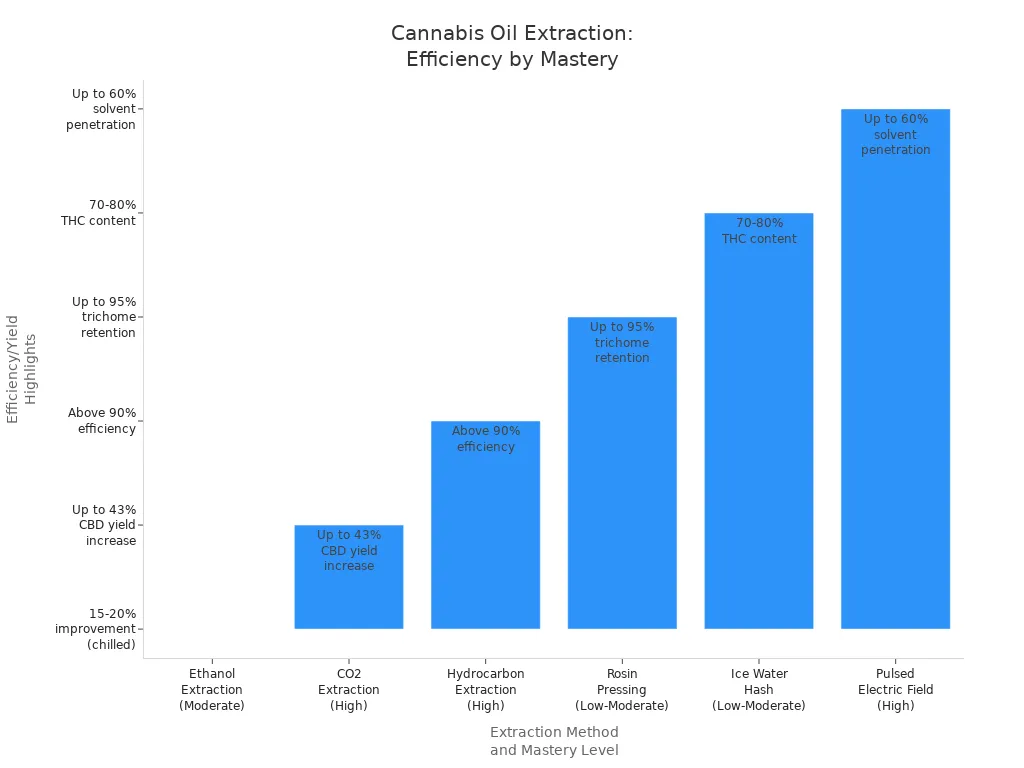
| Extraction Method | Equipment Mastery Level | Efficiency & Yield Highlights | Safety & Cost Considerations |
|---|---|---|---|
| Ethanol Extraction | Moderate | Efficiency improves 15-20% with chilled ethanol; requires winterization to remove impurities. | Low equipment cost; FDA approved solvent; moderate safety risk |
| CO2 Extraction | High | Precise control yields high-quality extracts; preprocessing (moisture reduction) can increase CBD yield by 43%. | High initial investment ($50k-$200k+); low safety risk; reusable CO2 |
| Hydrocarbon Extraction | High | Extraction efficiency above 90%; preserves delicate terpenes. | High safety risk due to flammability; requires closed-loop systems |
| Rosin Pressing | Low to Moderate | Up to 95% trichome retention; good yields with minimal equipment investment ($500-$5,000). | Safe, solventless; suitable for beginners; preserves terpene profiles |
| Ice Water Hash | Low to Moderate | THC content 70-80%; labor-intensive, limiting scalability. | Safe, solventless; artisanal method; premium product pricing |
| Pulsed Electric Field | High | Improves solvent penetration by up to 60%; reduces drying time and energy consumption. | Advanced technology; benefits skilled operators |
You can see that the cannabis extraction process becomes more productive and cost-effective as you gain experience with your equipment.
Safety precautions are essential in every cannabis oil extraction process. You must use proper ventilation, explosion-proof equipment, and personal protective equipment (PPE) to protect yourself and your team.
Certified equipment and strict safety protocols help you avoid accidents and meet national standards like ANSI/CAN/UL/ULC 1389. When you master your cannabis extraction equipment, you protect your business, your team, and your customers.

You have several cannabis oil extraction methods to choose from, each with unique benefits and equipment needs. The method you select shapes the quality, purity, and yield of your extracted cannabis oil. Understanding these methods helps you match your goals with the right cannabis extraction process.
Solvent-based extraction methods use chemicals like CO2, ethanol, or hydrocarbons to pull cannabinoids and terpenes from cannabis. These methods work quickly and deliver high yields of cannabis oils. You need specialized equipment, such as pressurized chambers and solvent recovery systems, to handle these processes safely.
| Extraction Method | Efficiency and Yield | Product Quality and Notes |
|---|---|---|
| Solvent-Based | Highly efficient; extracts broad spectrum of cannabinoids and terpenes | High-quality extracts with robust flavors; requires solvent purging; safety concerns with flammable solvents |
CO2 extraction stands out for its clean, precise results and safety. Ethanol extraction is cost-effective and scalable, but it may pull unwanted compounds like chlorophyll. Hydrocarbon extraction produces potent cannabis extracts with strong flavors, but you must use explosion-proof equipment. Solvent-based extraction methods suit large-scale cannabis oil extraction and deliver consistent, high-quality oils.
Solventless extraction methods use only heat, pressure, ice, or filtration. You avoid chemical solvents, making these methods safer and simpler. Rosin pressing and ice water extraction are popular choices. You can use basic equipment, such as a rosin press or ice water bags, to create pure cannabis oils.
| Extraction Method | Efficiency and Yield | Product Quality and Notes |
|---|---|---|
| Solventless | Simpler, less equipment; lower yield compared to solvent-based methods | Produces pure concentrates without solvents; preserves full cannabinoid and terpene profiles; may contain more impurities |
Solventless extraction methods preserve the full cannabinoid and terpene profile of cannabis. You get pure, full-spectrum cannabis extracts with rich flavors and aromas. These methods appeal to health-conscious users and medical patients who want solvent-free oils. However, you may see lower yields compared to solvent-based extraction methods.
Steam distillation uses steam to separate essential oils from cannabis. This method works gently, preserving delicate terpenes and aromatic compounds. You need a distillation setup with a steam generator and collection vessel.
| Extraction Method | Efficiency and Yield | Product Quality and Notes |
|---|---|---|
| Steam Distillation | Slower and less efficient for cannabinoids extraction | Gentle on delicate terpenes; preserves aromatic compounds; mainly used for essential oils; less effective for THC/CBD |
Steam distillation is best for extracting terpene-rich cannabis oils. You will not get high yields of cannabinoids like THC or CBD. This method suits producers who want aromatic cannabis oils for wellness or fragrance products.
Tip: Your choice of cannabis oil extraction methods affects the equipment you need, your safety protocols, and the final quality of your extracted cannabis oil. COFF offers advanced solutions for every extraction method, helping you achieve superior results.
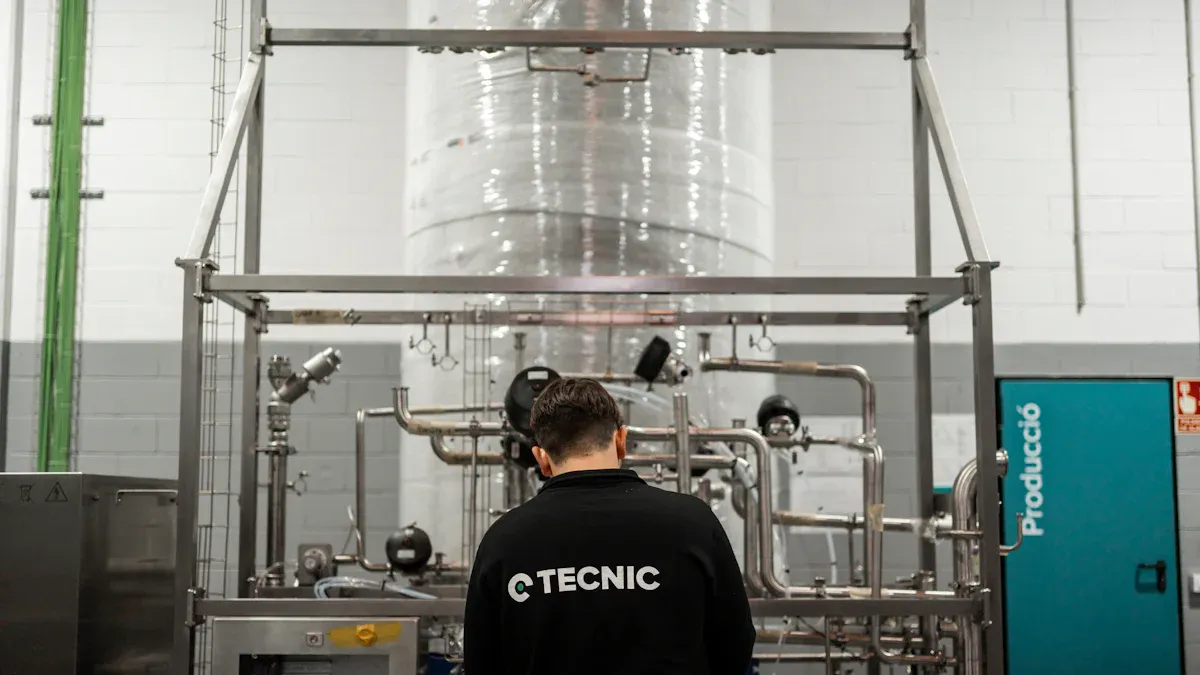
You use pressurized chambers as the heart of cannabis extraction equipment. These chambers hold cannabis plant material and solvents under controlled conditions. The chamber’s design lets you manage pressure and temperature, which is vital for extracting cannabinoids and terpenes from cannabis. Most chambers use SUS 304 stainless steel, which meets GMP standards and resists corrosion. You find features like sight glasses for real-time monitoring, sanitary clamps for easy cleaning, and precise valves for flow control. The table below shows key specifications:
| Specification Aspect | Details/Values |
|---|---|
| Material of Construction | SUS 304 Stainless Steel, optional 316L |
| Extraction Tank Capacity | 120 Liters |
| Vacuum Degree | 0 to -0.08 MPa |
| Temperature Precision | ±2°C |
| Jacket Structure | Three-layer for heating and insulation |
| Valves | Two, for solvent control and pressure release |
You rely on these features to keep your cannabis extraction process safe, efficient, and hygienic. COFF designs chambers that make assembly and cleaning simple, helping you maintain high-quality extracted cannabis oil.
Solvent recovery systems help you reclaim over 95% of solvents used in cannabis oil extraction equipment. You reduce hazardous waste and save money by recycling solvents like ethanol or butane. These systems use closed-loop designs, which keep operators safe and support compliance with cGMP and OSHA rules. You benefit from accurate temperature control, which activates cannabinoids and improves the potency of extracted cannabis oil. Solvent recovery also means less manual handling, faster processing, and cleaner cannabis oils. COFF’s advanced systems integrate seamlessly with your cannabis extraction equipment, boosting efficiency and safety.
Filtration units remove unwanted plant materials from extracted cannabis oil. You can choose between powdered and granular filter media. Granular media, such as silica gel or diatomaceous earth, offer easier handling, less mess, and better retention of cannabinoids and terpenes. You avoid clogging and reduce health risks from powder inhalation. Granular filtration works at low pressure, which preserves the flavor and aroma of your cannabis oils. You can combine different media to reach your purification goals. COFF provides filtration units that support both traditional and modern filtration methods, ensuring your cannabis extraction equipment delivers pure, potent oils.
Evaporation equipment, like rotary evaporators, removes solvents from extracted cannabis oil after filtration. You use this step to concentrate your cannabis oils and improve purity. Rotary evaporators work efficiently, preserving cannabinoids and terpenes for better flavor and stability. Modern systems can combine evaporation, cooling, and filtration, which speeds up your workflow and increases throughput. You get cleaner, safer, and more consistent extracted cannabis oil. COFF supplies evaporation equipment that fits seamlessly into your cannabis extraction equipment lineup, helping you achieve top-quality oils every time.
You use CO2 cannabis extraction systems when you want clean, pure cannabis oils. This cannabis extraction equipment uses carbon dioxide in a supercritical state. You pressurize and heat CO2 above 31.1°C and 1071 psi. The supercritical CO2 passes through cannabis material, dissolving cannabinoids and terpenes. You then lower the pressure to separate the extract from the CO2 gas, which you recycle back into the system.
Tip: COFF offers advanced CO2 cannabis extraction equipment designed for safety, efficiency, and easy operation.
Ethanol units are popular cannabis extraction equipment for large-scale production. You use ethanol, a Class 3 solvent, to extract both water-soluble and oil-soluble compounds from cannabis. This method works well for cannabis alcohol extraction because it is affordable and scalable.
| Feature | Benefit/Consideration |
|---|---|
| Automation | Reduces solvent use, boosts efficiency |
| Scalability | Handles large cannabis batches |
| Safety | Needs proper ventilation and fire controls |
| Purity | Requires extra steps for high cannabinoid levels |
You choose ethanol units when you want a balance of cost, speed, and broad-spectrum cannabis oil.
Hydrocarbon extractors use butane or propane to pull cannabinoids and terpenes from cannabis. This cannabis extraction equipment gives you high yields and preserves delicate flavors. You must use these systems in Class 1, Division 1 rooms because hydrocarbons are flammable.
Note: COFF’s cannabis hydrocarbon extraction equipment meets strict safety standards and supports third-party certification for your peace of mind.
Solventless tools let you extract cannabis oils without chemicals. You use rosin presses, ice water hash systems, or dry sift screens. Rosin presses apply heat and pressure to cannabis, preserving terpenes and cannabinoids. Ice water hash uses cold water and agitation to separate trichomes. Dry sift involves sifting cannabis through fine mesh screens.
| System | Scale | Capacity (Dry/Fresh Frozen) | Runtime (hours) | Expected Yield (Dry/Fresh Frozen) |
|---|---|---|---|---|
| WT-PILOT | Lab Scale | Up to 20 lbs / Up to 66 lbs | 0.5–2 | 10–30% / 2–7% |
| WT-MICRO | Commercial | Up to 13 lbs / Up to 44 lbs | 1–2 | 10–30% / 2–7% |
| WT-CRAFT+ | Commercial | Up to 33 lbs / Up to 100 lbs | 2–3 | 10–30% / 2–7% |
| WT-2000 | Industrial | Up to 60 kg / Up to 300 kg | 4–6 | 10–30% / 2–7% |
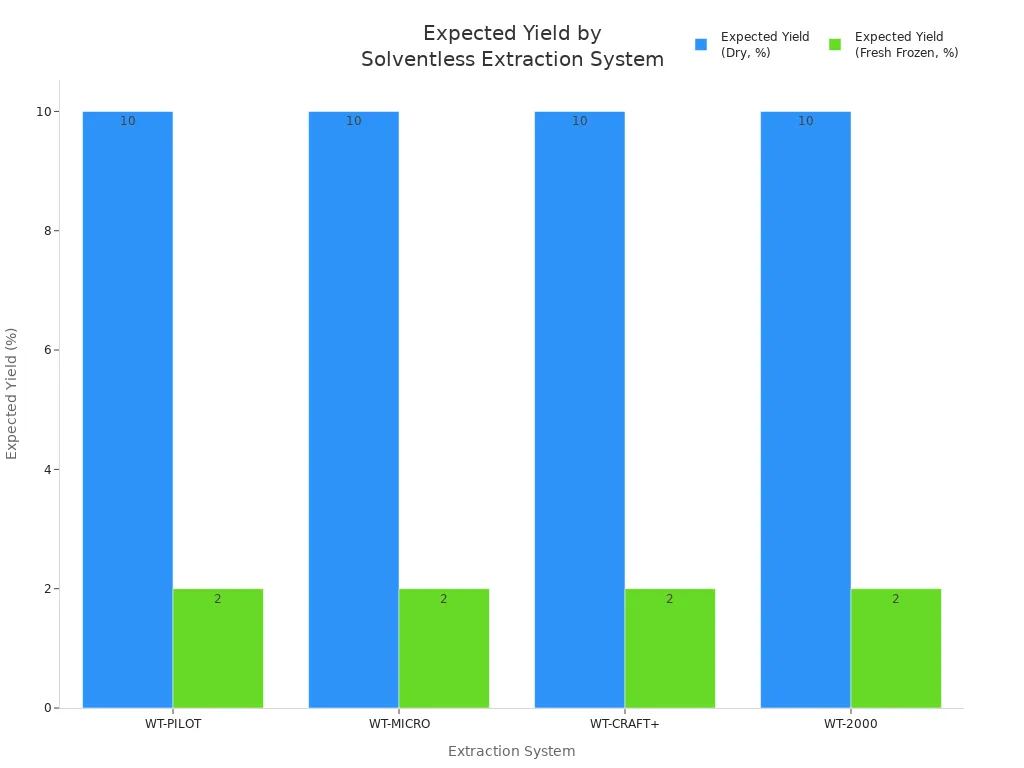
You get clean, full-spectrum cannabis concentrates with these methods. Solventless cannabis extraction equipment is easy to use and safe for both home and commercial settings. COFF provides reliable tools for every scale, helping you maintain quality and flavor in your cannabis products.
Selecting the right equipment shapes your cannabis oil extraction results. You need to match your equipment to your product goals, production scale, budget, and compliance needs. Careful planning helps you avoid costly mistakes and supports long-term success.
You should start by defining your product goals. The type of cannabis oil you want to produce will guide your equipment choices. For example, if you want pure, solvent-free concentrates, you may choose rosin presses or ice water hash systems. If you need high-purity oils for vape cartridges or tinctures, you may select CO2 or ethanol extraction systems.
Consider these factors when matching equipment to your product goals:
Tip: COFF’s team can help you identify the best equipment for your product goals, ensuring you meet quality and safety standards.
You need to match your equipment to your production scale and budget. Small operations may use compact CO2 or hydrocarbon extractors, while large facilities often choose ethanol systems for higher throughput. Industry benchmarks show that top-performing facilities keep cost of goods sold (COGS) at 35%-45% of total production costs. You can reduce these costs by 10%-15% through lean manufacturing and smart supplier choices.
| Production Scale | Equipment Type | Example Capacity | Typical Use Case |
|---|---|---|---|
| Small/Lab | Rosin Press, Small CO2 Unit | 1-20 lbs/day | Craft, R&D, Boutique Products |
| Medium/Commercial | CO2, Hydrocarbon, Ethanol | 20-100 lbs/day | Dispensaries, Regional Brands |
| Large/Industrial | Ethanol, Large CO2 Systems | 100+ lbs/day | National Brands, Bulk Production |
You should also consider facility constraints, such as hazardous material storage and local zoning rules. Leading brands like Luna Technologies, Eden Labs, and Vitalis Labs offer equipment for every scale, from pilot to industrial. COFF provides modular equipment that adapts to your growth, helping you control costs and boost efficiency.
You must follow strict compliance rules when choosing cannabis oil extraction equipment. Equipment must meet US regulations and industry safety standards. Safety features help you minimize risks during extraction. Quality control ensures your final product meets legal requirements.
Key compliance requirements include:
Note: COFF’s equipment meets global safety and quality standards, including ASME and AS1210 certifications. You can rely on COFF for equipment that supports compliance in every major market.
Choosing the right equipment means balancing your product goals, production scale, budget, and compliance needs. You can consult COFF’s experts for tailored solutions that help you achieve superior results and long-term success.
You need a smart facility layout to get the best results from your cannabis oil extraction equipment. Start with a linear workflow. Raw cannabis should enter on one side, and finished products should exit on the other. This setup reduces contamination and keeps your process efficient. Separate each stage—extraction, filtration, evaporation, and packaging—into its own area. Give your team enough space to move and operate equipment safely.
Always follow local, state, and federal rules for cannabis facilities. Install proper ventilation to remove toxic gases and control temperature and humidity with HVAC systems. Use access control and cameras for security. Plan for future growth by leaving room for more equipment. Train your staff on safety and extraction techniques. COFF can help you design a layout that meets all safety and efficiency standards.
Proper installation keeps your operation safe and compliant. Use equipment and electrical parts rated for flammable vapors, such as Class I, Division 1. Install explosion-proof motors and make sure all machines are certified by trusted labs. Set up exhaust and ventilation systems that meet fire safety codes like NFPA 1 and NFPA 70. Ground and bond all electrical systems to prevent sparks.
Follow these steps for a smooth installation:
COFF’s team supports you through every step, ensuring your equipment meets all safety and quality standards.
Calibration ensures your cannabis oil extraction equipment works accurately every time. Use calibrated machines for precise dosing and record every batch for traceability. Regularly check and adjust pressure sensors, flow meters, and temperature controls. Train your technicians to clean, reset, and fill machines correctly.
Never use uncalibrated equipment. This can cause errors in your product and waste valuable material. COFF supplies equipment with factory calibration certificates and offers guidance on keeping your system in top shape. Consistent calibration means you deliver safe, high-quality cannabis oil with every batch.
Standard Operating Procedures (SOPs) guide you through every step of cannabis oil extraction. You rely on SOPs to keep your process safe, consistent, and efficient. Well-written SOPs help you avoid mistakes and improve your results.
Cleaning procedures form a key part of your SOPs. You must validate cleaning steps to remove residues and contaminants. This involves swab testing, rinse testing, microbial monitoring, and visual inspections.
Proper SOPs ensure product purity, prevent contamination, extend equipment lifespan, and support regulatory compliance. COFF provides guidance and templates to help you set up effective SOPs for your extraction equipment.
You must monitor key parameters during cannabis oil extraction to maintain quality and safety. These parameters help you produce consistent, safe, and high-quality oils.
Safety parameters are just as important:
Operational parameters also need attention:
COFF extraction systems come with built-in monitoring features and support documentation, making it easier for you to track these key parameters and maintain compliance.
You may face challenges when operating cannabis oil extraction equipment. Knowing how to troubleshoot common issues keeps your process running smoothly and safely.
Here are steps you can take to solve common problems:
COFF offers certified, automated extraction equipment and expert support to help you troubleshoot and resolve issues quickly. This ensures you maintain high productivity and product quality.
You keep your cannabis oil extraction equipment in top shape by following strict cleaning protocols. Clean equipment prevents contamination and ensures every batch meets quality standards. Use the right cleaning agents, such as alkaline cleaners, isopropyl alcohol, ethanol, and hydrogen peroxide. Always check that these agents work safely with your equipment materials.
Follow these steps for effective cleaning:
Tip: COFF equipment supports easy cleaning and comes with clear SOPs to help you maintain high standards.
You extend the life of your equipment with regular preventive care. This keeps your operation running smoothly and reduces costly downtime.
COFF designs equipment for easy maintenance, helping you protect your investment.
You boost efficiency and product quality by upgrading your equipment. New features like automated controls, improved filtration, and advanced monitoring systems can make your process safer and more productive. Upgrades also help you meet new compliance rules and scale your business.
COFF offers upgrade options and technical support, so you can keep your extraction operation at the cutting edge.
You need to monitor your extraction process at every stage. In-process checks help you catch problems early. You can measure temperature, pressure, and solvent levels during extraction. You should also check for leaks and equipment malfunctions. Use visual inspections to spot residue or contamination. Sampling at key points lets you test for cannabinoid content and unwanted materials. These steps help you produce high-quality extracts every time. COFF equipment includes features that make in-process checks easy and reliable.
You must test your final product before you send it to customers. Lab tests check for potency, purity, and safety. You can measure THC and CBD levels to make sure your product meets legal standards. Labs also test for pesticides, heavy metals, and residual solvents. You want to confirm that your high-quality extracts are free from harmful substances. Many states require third-party testing and certificates of analysis. COFF supports you by designing equipment that helps you meet strict testing requirements.
You need to keep clear records for every batch you produce. Good documentation tracks your process from start to finish. You should record raw material sources, equipment settings, test results, and cleaning logs. This information helps you trace any problems and prove compliance during audits. Use digital logs or paper forms, but make sure your records are easy to read and store. COFF provides templates and support to help you set up strong documentation systems. Accurate records protect your business and show your commitment to quality.
You must follow both local and federal rules when you run a cannabis oil extraction operation. Each state sets its own laws for cannabis production, labeling, and sales. Some states require special licenses for extraction. You need to check your state’s cannabis control board for the latest rules. Federal agencies like the FDA and OSHA also set safety and health standards. You must keep your facility clean and safe. You must track every batch from seed to sale. If you ship products across state lines, you need to follow federal transport laws.
Tip: Always keep a checklist of your state and federal requirements. Update it when laws change.
You need certified equipment to meet safety and quality standards. Look for certifications like UL, ASME, and C1D1/C1D2. These show that your machines meet strict safety codes. Certified equipment helps you pass inspections and lowers your risk of accidents. Inspectors often check for these labels during visits.
| Certification | What It Means | Why It Matters |
|---|---|---|
| UL | Electrical safety | Prevents fire and shock |
| ASME | Pressure vessel safety | Ensures safe operation |
| C1D1/C1D2 | Explosion-proof design | Safe for flammable solvents |
COFF provides equipment with ASME and AS1210 certifications. You can trust COFF to help you meet compliance in any market.
You must prepare for audits to keep your license and protect your business. Auditors check your records, equipment, and safety systems. You should keep logs of cleaning, maintenance, and batch production. Store all certificates and test results in one place. Train your team to follow SOPs and safety rules every day.
Note: COFF supports you with documentation templates and compliance advice. You can rely on COFF to help you pass audits with confidence.
You want equipment that lasts and performs at the highest level. COFF builds extraction systems using high-end stainless steel. You get vessels made from SUS 304 or 316L, which resist corrosion and meet strict hygiene standards. COFF’s team includes engineers with over 15 years of experience. They design every detail for safety and efficiency. You benefit from equipment that holds ASME and AS1210 certifications. These certifications show that your system meets international safety and quality standards.
When you choose COFF, you invest in equipment that supports your business for years.
You need solutions that fit your unique process. COFF focuses on customer-oriented research and development. You can work with COFF’s engineers to create custom extraction systems. The team listens to your needs and helps you solve challenges. COFF offers technical support before and after installation. You get clear SOPs, training, and fast answers to your questions.
COFF’s service helps you stay ahead in a fast-changing industry.
You want a partner with a proven track record. COFF supplies extraction equipment to customers in the U.S., Canada, the UK, Australia, Japan, and more. Over 80% of new clients come from recommendations. More than 90% of customers build long-term partnerships with COFF. You join a global network of successful producers when you choose COFF.
| Region | Customer Satisfaction | Long-Term Partnerships |
|---|---|---|
| North America | ⭐⭐⭐⭐⭐ | 90%+ |
| Europe | ⭐⭐⭐⭐⭐ | 90%+ |
| Asia-Pacific | ⭐⭐⭐⭐⭐ | 90%+ |
Ready to upgrade your extraction process? Contact COFF for custom cannabis oil extraction equipment solutions.
You can achieve superior results by mastering your cannabis oil extraction equipment. Careful equipment selection, proper operation, and regular maintenance help you produce safe, high-quality oils.
Ready to take your extraction to the next level? Contact COFF to learn more about their advanced equipment and services.
You should use food-safe cleaners like isopropyl alcohol or ethanol. Rinse all parts with clean water. Dry everything before use. Always follow the cleaning steps in your equipment manual.
You should calibrate your equipment before each production run. Regular calibration keeps your results accurate and helps you meet safety standards.
Certified equipment meets safety and quality rules. It helps you pass inspections and protects your team. COFF provides equipment with ASME and AS1210 certifications.
Yes! COFF’s engineers work with you to create custom systems. You get equipment that fits your process and meets your goals.
Look for explosion-proof motors, automatic shutoffs, and gas detectors. Good ventilation and fire suppression systems are important. COFF includes these features in their equipment.