


COPYRIGHT © 2022 COFF International Co., ltd. ALL RIGHTS RESERVED


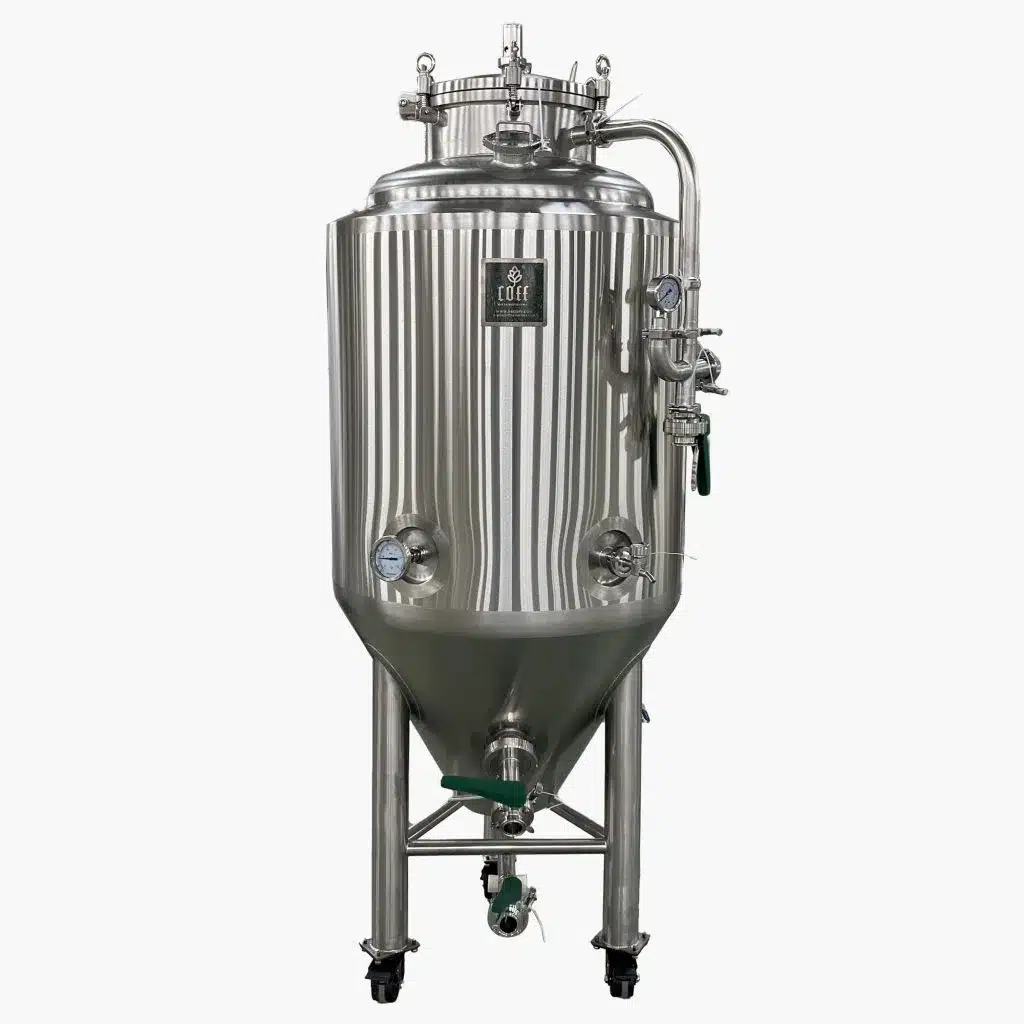
明るいビールタンク (also called ブライトタンク) are the final conditioning vessels in the brewing process, turning freshly fermented beer into clear, carbonated, packaging-ready product. For many breweries, they are the critical link between fermentation and packaging — think of fermenters as the engine of your brewery and bright tanks as the transmission that keeps production running at full speed.
While unitanks can handle both fermentation and conditioning, dedicated bright beer tanks deliver clearer beer, more consistent carbonation, faster fermenter turnaround, and greater scheduling flexibility.

Bright beer tanks help breweries control the final stages of beer production after fermentation. Their main benefits include improved clarity, controlled carbonation, and more consistent conditions before packaging or serving.
A bright beer tank provides a controlled environment where beer can be held cold and undisturbed, allowing remaining yeast and suspended particles to settle. Depending on the brewing process, breweries may also use filtration, fining, or centrifugation before or during this stage.
The result can be a clearer and more visually consistent beer. A bright tank therefore supports final clarification without making the tank itself the sole clarification method.
Because bright beer tanks are pressure-rated, brewers can control carbonation more precisely than when relying only on fermentation. CO₂ can be introduced through a carbonation stone or added inline, depending on the brewery’s process.
Carbonation targets vary by beer style and process, so temperature and pressure should be set according to the required CO₂ level and the tank manufacturer‘s specifications. This controlled approach helps maintain more consistent carbonation from batch to batch.
Bright tanks provide a dedicated vessel for holding finished beer under controlled temperature and pressure before packaging or serving. Keeping the beer in a closed, controlled system can also help limit unnecessary oxygen exposure during transfers and storage.
This makes the bright tank an important final-stage vessel for breweries that need consistent beer quality before kegging, bottling, or canning.

Bright beer tanks can improve brewery workflow by separating fermentation from final conditioning and packaging. This allows breweries to use fermentation vessels more efficiently while giving production teams greater control over downstream processing.
Once fermentation is complete, beer can be transferred from the fermenter to a dedicated bright beer tank. This releases the fermenter for another batch instead of keeping it occupied during final conditioning or holding.
The actual time saved depends on fermentation requirements, conditioning time, tank capacity, and the brewery’s production schedule. However, separating these stages can improve the utilization of existing fermentation capacity.
Cold storage and natural settling in a bright beer tank can help remove some suspended solids before packaging. Depending on the beer style and required clarity, this may reduce the amount of downstream filtration or other clarification required.
Bright beer tanks can also be equipped with CIP connections or systems that support consistent cleaning procedures. This can simplify sanitation between batches and integrate cleaning into the brewery’s existing process.
Bright beer tanks are available in different sizes and configurations, allowing breweries to match tank design to available cellar space. Vertical tanks can provide substantial capacity without requiring as much floor area, while horizontal configurations may be useful where ceiling height is limited.
Choosing the appropriate tank dimensions and orientation can help breweries organize fermentation, conditioning, packaging, and storage areas more efficiently.
A dedicated bright beer tank creates a buffer between fermentation and packaging. Instead of requiring these stages to occur in a fixed sequence, breweries can hold conditioned beer while preparing downstream packaging operations.
Bright beer tanks are available in a wide range of capacities, making them suitable for different brewery production volumes. The appropriate tank size depends on factors such as the number of fermenters, batch volume, fermentation time, packaging throughput, beer style, and required holding time.
Instead of following a universal tank-to-fermenter ratio, breweries should size bright beer tanks around their actual production workflow and expected demand.
Bright beer tanks can be configured with features such as cooling jackets, insulation, carbonation stones, pressure controls, sample ports, and CIP connections. Tank dimensions, orientation, fittings, and accessories can also be adapted to the brewery’s facility and production process.
This flexibility allows breweries to select a bright beer tank that fits their available space, operating requirements, and packaging workflow rather than relying on a standard configuration.
A bright beer tank clarifies and carbonates beer after fermentation. Brewers transfer finished beer into this tank. Yeast and solids settle to the bottom. Pressure systems hold carbonation steady. The beer becomes clear and ready for packaging.
Finished beer rests in a bright beer tank for 24 to 48 hours. This short period allows carbonation and clarification. Brewers can package directly from the bright beer tank afterward. The quick turnaround keeps production schedules flexible.
A small brewery can start with one bright beer tank sized 1 to 1.5 times its batch. Mid-sized breweries often pair three or four fermenters with two bright beer tanks. Each bright beer tank should match packaging speed and weekly targets.