

COPYRIGHT © 2022 COFF International Co., ltd. ALL RIGHTS RESERVED


There is no universal best tank material for every facility — the right choice depends on your plant’s corrosion exposure, hygiene requirements, budget, and maintenance capacity. Carbon steel delivers high structural strength at a lower upfront cost for low-corrosion, cost-sensitive service, while stainless steel offers inherent rust resistance and minimal maintenance for corrosive, hygienic, or high-purity applications.

Carbon steel’s strength and structural integrity scale with its carbon content. Low-carbon grades (≤0.25% C) offer tensile strengths of 300–450 MPa, while medium and high-carbon grades reach 500–1,200 MPa. The material also has good heat transfer characteristics and excellent weldability, making it a standard for welded pressure vessels per ASME and ASTM standards.
Stainless steel’s corrosion resistance comes from a minimum 10.5% chromium content, which forms a thin, self-healing oxide layer that protects against oxygen and moisture — even after minor scratches. This passive protection extends through the full wall thickness, eliminating the need for internal recoating.
| ファクター | 炭素鋼 | ステンレス鋼 |
|---|---|---|
| Natural corrosion resistance | Poor; bare steel rusts rapidly in moist/chemical environments | Excellent; self-healing chromium oxide layer protects full wall thickness |
| Protection method | Requires external coating, galvanizing, or interior lining | Inherent passive protection; no coating required |
| Common failure modes | Rust particle contamination, filter clogging, pump wear from abrasion | Microcracking in extreme chloride environments (grade-dependent) |
| Typical service life | 5–15 years with proper coating maintenance | 30–50+ years with routine inspection and cleaning |
Carbon steel tanks are most vulnerable to internal corrosion from trace moisture and dissolved oxygen, which produces abrasive iron oxide rust particles that contaminate stored fluids, clog filters, and accelerate pump wear. Galvanizing (zinc sacrificial anode coating) or epoxy/rubber linings can extend service life, but require regular reapplication.
Stainless steel needs no internal coating program, and its smooth, dense surface resists buildup and contamination. Higher-chloride environments may require upgraded grades (e.g. 316 duplex vs. 304), but standard grades perform well in most general corrosive and sanitary services.

| コスト係数 | 炭素鋼 | ステンレス鋼 |
|---|---|---|
| Upfront purchase cost | 30–50% lower | Higher, driven by nickel/chromium raw material pricing |
| Recurring maintenance | Regular recoating/relining every 5–10 years; production downtime during work | Near-zero internal maintenance; only periodic inspection and cleaning |
| Total cost of ownership | Lower for short service life; higher over 20+ years due to recoating and downtime | Higher upfront, but lower over 20+ year lifespans due to minimal maintenance |
The total cost calculation flips over time: carbon steel wins on upfront price, but stainless steel’s low maintenance and long service life usually deliver better total value over 20+ years of operation, especially for facilities with limited maintenance staff.
Carbon steel is the workhorse of industrial storage for cost-sensitive, low-to-moderate corrosion service:
Stainless steel is the standard for hygienic, corrosive, and high-purity applications:
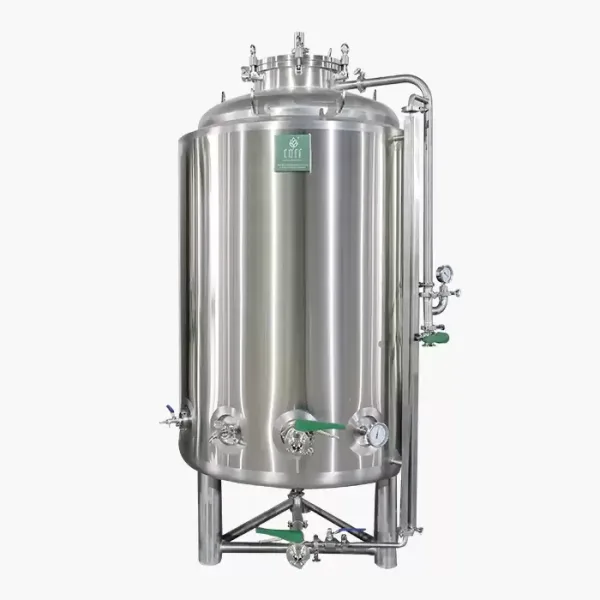
For example, COFF supplies SUS304 食品用ステンレスタンク from 1,000L to 20,000L for beverage, dairy, and pharmaceutical applications, with atmospheric, pressure-rated, or jacketed configurations available.
With proper routine inspection and cleaning, ステンレスタンク last 30–50 years. Their self-healing chromium oxide layer provides inherent rust protection, so internal maintenance is minimal.
Yes, bare carbon steel will rust rapidly when exposed to moisture or chemicals. Most facilities use epoxy linings, rubber coatings, or hot-dip galvanizing for protection. Coated tanks require recoating every 5–10 years to maintain performance.
Carbon steel costs 30–50% less upfront, but requires regular recoating and has associated downtime costs. Stainless steel has a higher initial price, but its low maintenance and long service life usually deliver a lower total cost of ownership over 20+ years of operation.
Yes. Tight sealing contains volatile compounds, and jacketed glycol cooling maintains precise temperature control. Mirror-polished interiors clean quickly between batches, making stainless steel suitable for both small craft producers and large wineries.
COFF produces SUS304 food-grade tanks from 1,000L to 20,000L, with atmospheric, pressure-rated, or jacketed configurations in vertical or horizontal designs. Mixing systems and CIP cleaning are available as options, and all tanks come with a three-year warranty.